
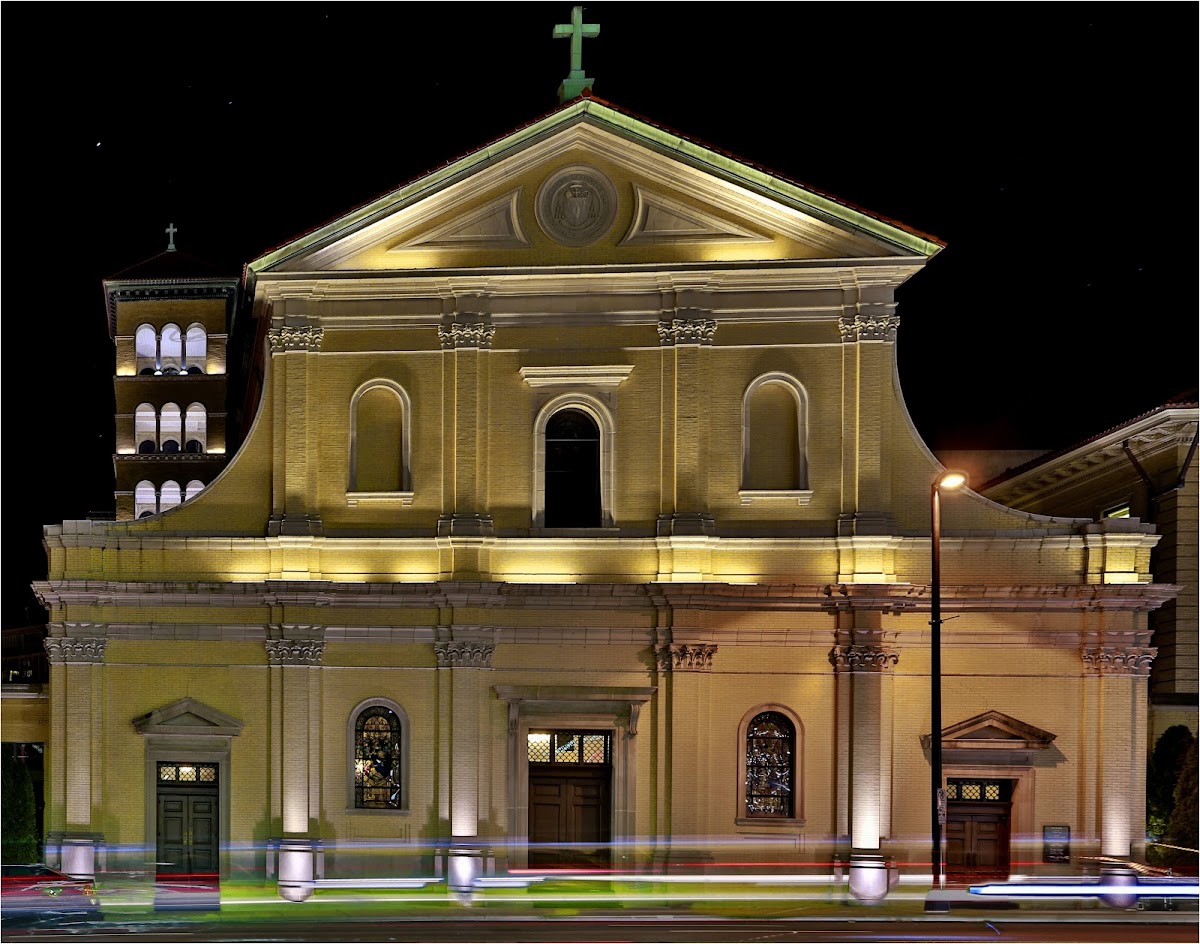
You turn off West End Avenue, and suddenly there it is — limestone rising toward the Nashville sky, Gothic tracery and pinnacles silhouetted against a backdrop of Midtown glass and steel. The Cathedral of the Incarnation does not ease into view. It announces itself. You park on a side street near Vanderbilt’s campus, walk past undergraduates clutching coffee cups, and then you are standing at the carved wooden doors of a building that has anchored this corner since 1914, when Nashville was a very different place. Inside, the world narrows and then expands all at once. The ceiling soars sixty-five feet overhead, coffered and painted in gold and Marian blue, the colors of heaven rendered in plaster and light. Stained glass windows — jewel-toned reds, blues, greens — cast prisms across limestone walls. The air smells faintly of incense and old wood and silence, the particular quiet that only stone buildings of a certain age seem to hold. This is not a venue that requires florals to impress. It impresses on its own. But Cathedral of the Incarnation wedding flowers, done thoughtfully, can honor this space in a way that feels both reverent and beautiful. Poppy has received 9 inquiries from couples planning weddings here, and while we have not yet had the privilege of designing florals within these walls, we know sacred spaces. We understand how to bring flowers into a room where the architecture is already singing.
About Cathedral of the Incarnation
The Cathedral of the Incarnation is the seat of the Catholic Diocese of Nashville, completed in 1914 in the Gothic Revival style and modeled after the Basilica di San Martino ai Monti in Rome. The building was designed by architect Adolphus Druiding, who also designed churches across Tennessee and the South, and its construction represents one of the most ambitious ecclesiastical projects in Nashville’s history. The exterior is clad in Indiana limestone, carved with Gothic details — pointed arches, quatrefoils, flying buttresses — that evoke the great cathedrals of medieval Europe. Inside, the nave stretches long and high, flanked by columns that support those gold-and-blue coffered ceilings. Between each column, the Stations of the Cross are mounted — hand-painted depictions in carved wooden frames, each a work of devotional art. The stained glass windows were installed in phases over the decades, some original to the 1914 construction, others added as the parish grew and funds allowed. The effect is cumulative: light filtered through colored glass, stone warmed by time, woodwork polished by a century of hands.
The sanctuary underwent a major restoration between 2014 and 2021, a phased project that returned the altar, chapels, and decorative elements to their original grandeur while updating infrastructure. The new altar — simple, classical, crafted from stone — sits beneath a wooden Corpus and is flanked by faux porphyry columns and Della Robbia-style bas relief sculptures depicting scenes from the life of Christ. The Annunciation Chapel and Crucifixion Chapel, tucked to either side of the main nave, were restored with trompe l’oeil ceiling panels and custom decorative wallcovering, creating intimate spaces suitable for smaller ceremonies or private prayer. These side chapels offer an alternative for couples seeking a more personal setting, though the main sanctuary remains the primary draw.
The Cathedral sits at 2015 West End Avenue, directly across from Centennial Park and adjacent to Vanderbilt University, in the heart of Nashville’s Midtown neighborhood. This is an upscale, walkable area dense with historic architecture, tree-lined streets, and the intellectual energy of a major university. Music Row is a ten-minute drive south; downtown Nashville is fifteen minutes east. For florists, the location is straightforward — major thoroughfares (West End Avenue, I-440, I-65) provide easy access, and loading for events typically takes place through a side entrance where we can stage arrangements out of sight of arriving guests. Parking for guests is a mix of on-street metered spaces and nearby garages; the Cathedral does not have a private lot, which is worth communicating clearly in your wedding details.
The Cathedral offers wedding ceremonies for practicing Catholics, typically requiring pre-marriage preparation through the parish. The Fleming Center, a reception hall within the Cathedral complex, is available for post-ceremony receptions, which solves one of the great logistical challenges of church weddings: guest transportation. Couples can marry in the sanctuary and move directly to the reception without shuttles or caravan drives across town. The Fleming Center allows outside catering, which gives flexibility in menu and style, though alcohol policies should be confirmed with the parish coordinator as they may be more restrictive than a secular venue.
Event Spaces & Floral Opportunities
Main Cathedral Sanctuary
Capacity: 400 seated
Setting: The Main Sanctuary is where the drama lives. You enter through the narthex and the space unfolds — a long nave flanked by massive stone columns, the ceiling soaring overhead in a canopy of blue and gold, the altar centered beneath the sanctuary arch at the far end. The stained glass windows run the length of both side walls, each one a narrative scene rendered in ruby, sapphire, emerald, and amber glass. Natural light floods the space during daytime ceremonies, casting colored patterns across the limestone floor and wooden pews. The scale is monumental. This is a room built for procession, for music swelling from the pipe organ, for the slow walk down a long aisle toward a single focal point. The architecture does not need help. It needs respect.
Floral approach: In a space this grand, scale and restraint are everything. The altar arrangements must be large enough to register from the back pew — we are talking substantial installations, at least five feet tall, built on sturdy urn-style vessels in aged brass or stone-look ceramic. Think Patience garden roses, Polo or White Ohara roses, white hydrangea, ivory stock, and white delphinium or larkspur for vertical interest, with trailing jasmine vine or smilax to soften the edges. The goal is classical, architectural florals that echo the Gothic verticality of the space without blocking the altar itself or the sanctuary’s decorative elements. Avoid anything overly rustic or wildflower-like; this room calls for structure. For the aisle, pew markers every third or fourth row are sufficient — small tied bunches of roses, lisianthus, and eucalyptus attached with wide silk ribbon in ivory or champagne. Do not use shepherd’s hooks or standing arrangements in the aisle unless specifically approved; the Stations of the Cross mounted between the columns are works of art and should remain visible. If the couple wants more aisle presence, consider a low garland or petals down the runner, but keep sightlines clear. The stained glass windows cast jewel tones throughout the day, so your palette must work with red, blue, green, and gold light playing across it. Whites, ivories, blushes, and soft champagnes are safest. Deep burgundy, plum, or navy can work beautifully if you lean into the jewel-tone echo, but avoid pastels that will look washed out under colored light.
Incarnation Chapel (Annunciation Chapel)
Capacity: Intimate ceremonies, approximately 40-50 guests
Setting: Tucked to the side of the main nave, the Annunciation Chapel is a smaller, more personal space with trompe l’oeil ceiling panels painted with symbols of the Annunciation — lilies, doves, angels — and custom decorative wallcovering that gives the room a jewel-box quality. A Della Robbia-style bas relief sculpture anchors one wall, and the altar is scaled for the space, simple and elegant. This chapel feels like a secret, a place where you could marry with just your closest family and feel the weight of the occasion without the grandeur overwhelming it.
Floral approach: The Annunciation Chapel requires a lighter touch. The altar arrangement should be smaller — perhaps 24 to 30 inches tall — and more delicate in execution. Consider a low, lush arrangement in a footed compote: Juliet garden roses, white ranunculus, blush spray roses, hellebores, and soft greenery like silver dollar eucalyptus or seeded eucalyptus. The ceiling’s painted lilies offer a thematic cue; incorporating white lilies (Casablanca or smaller LA hybrids) into the floral design creates continuity between the architecture and your florals. Pew or chair markers here can be very simple — single stems of roses or lisianthus tied with ribbon, or small tussy mussies in antique brass holders. The custom wallcovering is decorative enough that you do not need garlands or larger installations; let the room’s intimacy speak for itself.
Crucifixion Chapel
Capacity: Intimate ceremonies, approximately 40-50 guests
Setting: Similar in scale to the Annunciation Chapel, the Crucifixion Chapel features its own trompe l’oeil ceiling panels and custom wallcovering, though the thematic focus here is the Passion rather than the Annunciation. The mood is slightly more solemn, the colors deeper. This space works well for couples seeking a contemplative, intimate ceremony with a smaller guest list.
Floral approach: The Crucifixion Chapel benefits from slightly moodier floral tones. Consider a palette of ivory, blush, and soft burgundy — Patience and Quicksand roses, burgundy ranunculus, blush lisianthus, scabiosa, and dark foliage like burgundy leucadendron leaves or smoke bush. The altar arrangement should remain intimate in scale but can carry more tonal depth than the Annunciation Chapel’s lighter palette. A low, hand-tied bouquet style arrangement in a ceramic or stone vessel — something that looks organic and gathered rather than stiff — honors the solemnity of the space. Chair or pew markers can follow the same palette, with touches of dark foliage to ground the look.
Fleming Center
Capacity: Large receptions, approximately 200+ guests depending on configuration
Setting: The Fleming Center is the Cathedral’s adjacent reception hall, a blank-slate space that allows couples to bring in their own catering, rentals, and décor. It is a rectangular hall with neutral walls, standard ceiling height, and flexible floor space for various table configurations. The benefit is obvious: your guests walk from ceremony to cocktails to dinner without leaving the property. The downside is equally obvious: the Fleming Center has none of the architectural romance of the Cathedral itself. It reads banquet hall, not historic limestone sanctuary. Your florals and décor will need to do the heavy lifting.
Floral approach: This is where you can open up stylistically. If you kept the ceremony florals classical and restrained to honor the Cathedral’s architecture, the Fleming Center is your opportunity to bring in more personality. Tall centerpieces — 30 to 36 inches on clear glass or gold risers — create vertical interest in a room with standard ceilings. Consider lush garden-style arrangements with Café au Lait dahlias, Quicksand and Juliet roses, white or blush lisianthus, burgundy scabiosa, and mixed textured greenery. Alternate heights across tables to create visual rhythm. A long garland or low runner down the head table — smilax, Italian ruscus, seeded eucalyptus studded with roses and ranunculus — adds a sense of abundance. If the couple is repurposing ceremony arrangements, the large altar pieces can be moved to flank the head table or the entrance to the Fleming Center, creating continuity between ceremony and reception and maximizing the floral budget. Cocktail tables can feature smaller, simpler arrangements — bud vases or low compotes — to keep the focus and budget on the main reception tables. Consider uplighting or string lights to warm the space; florals alone will not transform a banquet hall, but florals combined with thoughtful lighting can.
Wedding Flower Ideas for Cathedral of the Incarnation
Basilica White
This concept honors the Cathedral’s Roman basilica inspiration with a palette drawn entirely from white, ivory, and cream blooms. White Ohara roses, Polo roses, white hydrangea, white delphinium, ivory stock, white lisianthus, and Casablanca lilies form the foundation, textured with seeded eucalyptus, Italian ruscus, and white veronica. Arrangements sit in antique brass urns, stone-look ceramic pedestals, or footed ivory compotes for a look that feels timeless and liturgical. The altar arrangements are substantial and architecturally structured — columnar, almost sculptural — echoing the Gothic verticality of the sanctuary. Pew markers are simple tied bunches of white roses and eucalyptus with wide ivory silk ribbon. In the Fleming Center, tall white arrangements on clear glass risers keep the ethereal quality going, while a head table garland of smilax and white roses ties everything together. This palette photographs beautifully against limestone and stained glass, never competing with the colored light but instead glowing within it. It is the safest choice for a Cathedral wedding, and safe does not mean boring — it means elegant, reverent, and utterly appropriate.
Jewel-Toned Vespers
This concept leans into the stained glass rather than working around it. The palette is saturated and rich: deep burgundy dahlias (Black Satin, Karma Choc), plum-toned garden roses (Keira, Deep Purple), burgundy ranunculus, navy blue delphinium or anemones, and touches of blush (Quicksand roses, Koko Loko garden roses) to lighten the intensity. Foliage includes burgundy leucadendron, smoke bush, and dark Italian ruscus. Arrangements sit in aged brass urns or dark ceramic vessels. The effect is opulent, moody, and deeply romantic — like the Cathedral itself at dusk, when the votive candles are lit and the stained glass windows glow from within. This palette works especially well for fall and winter weddings, and it pairs beautifully with jewel-tone bridesmaid dresses or black-tie attire. In the Fleming Center, this palette creates warmth and intimacy, especially when paired with candlelight and rich linens in burgundy, plum, or navy velvet.
Southern Gothic Romance
This concept nods to Nashville’s literary and cultural identity — not the Broadway neon, but the older, more complex South of Flannery O’Connor and Eudora Welty. The palette is soft but not saccharine: blush and ivory with unexpected depth. Café au Lait dahlias, Quicksand and Juliet garden roses, blush ranunculus, taupe lisianthus, white scabiosa, and hellebores in soft green and mauve tones. Foliage includes dusty miller, silver dollar eucalyptus, and trailing jasmine vine. Textural accents like scabiosa pods, privet berries, and bunny tail grass add an organic, slightly wild quality. Arrangements sit in aged brass compotes, stone vessels, or ceramic urns with a matte finish. The effect is romantic without being precious, soft without being predictable. This palette works beautifully with the Cathedral’s limestone and complements the stained glass without directly echoing it. In the Fleming Center, this palette creates a garden-party-meets-historic-estate vibe, especially if paired with taupe or mauve linens and mixed metallics.
Seasonal Considerations
Nashville experiences four true seasons, and each brings distinct opportunities and challenges for Cathedral of the Incarnation wedding flowers.
Spring (March through May) is peak wedding season in Nashville, when the humidity has not yet arrived and the city is lush with new growth. Temperatures range from the 60s to the 80s, and the risk of rain is higher than summer but manageable. Spring offers the most abundant local blooms: tulips, daffodils, ranunculus, anemones, peonies (late April through May), sweet pea, and flowering branches like dogwood and cherry. The Cathedral’s stained glass windows are particularly stunning in spring light — softer and more diffused than summer’s harsh glare. Spring weddings at the Cathedral often lean romantic and garden-inspired, with pastel palettes and abundant peonies if the timing allows. Be aware that Easter can affect availability at the Cathedral; confirm your date early.
Summer (June through August) in Nashville is hot and humid, with temperatures regularly in the 90s and afternoon thunderstorms common. The Cathedral is climate-controlled, which is a blessing, but load-in logistics require careful timing to avoid wilting blooms in the heat. Summer offers roses, hydrangeas, dahlias (mid to late summer), lisianthus, zinnias, and sunflowers, though we typically avoid sunflowers for Cathedral weddings unless the couple specifically requests them — they read more casual than this space calls for. Summer light is intense; the stained glass glows brilliantly, and your florals will be bathed in saturated color. Whites, ivories, and blushes work beautifully. Avoid delicate blooms like sweet pea or anything that wilts easily; stick with sturdy varieties. Hydrate everything thoroughly and deliver as close to ceremony time as possible.
Fall (September through November) is Tennessee’s secret best season. The humidity breaks in late September, temperatures cool to the 60s and 70s, and the light turns golden. Fall foliage in Nashville is understated compared to New England but lovely — soft golds, burnt oranges, russet reds. Fall offers the best dahlias of the year (Café au Lait, Koko Loko, Breakout), garden roses, roses, ranunculus, scabiosa, chocolate cosmos, and abundant foliage options. Fall weddings at the Cathedral often lean richer in tone — burgundies, plums, burnt oranges, creams — echoing the season outside. The stained glass windows look particularly beautiful in fall’s angled afternoon light. October is the busiest wedding month in Nashville; book early.
Winter (December through February) is Nashville’s quietest wedding season, but the Cathedral shines during Advent and Christmas when the sanctuary is decorated with evergreen garlands and poinsettias. Winter temperatures range from the 30s to the 50s, and while snow is rare, ice storms can disrupt logistics. Winter offers amaryllis, anemones, ranunculus, hellebores, tulips (imported), evergreen foliage, and berries. Winter weddings at the Cathedral often embrace a more formal, elegant aesthetic — whites, ivories, deep greens, touches of gold or silver. The stained glass windows filter the low winter light beautifully, creating a quieter, more contemplative atmosphere. If you are marrying close to Christmas, coordinate with the parish about existing décor; you may be able to incorporate the Cathedral’s evergreen garlands and candles into your design, reducing your floral budget while still achieving a lush look.
Poppy’s Expert Take
Respect the scale, or your florals will disappear. The Main Sanctuary’s 65-foot ceilings and 400-person capacity mean that small arrangements simply vanish. Your altar florals need to be at least four to five feet tall and proportionally full to register from the back pews. If you are working with a limited budget, it is better to invest in two large, dramatic altar arrangements than to spread the budget thin across multiple smaller pieces that will not be visible. Save the delicate bud vases for the Fleming Center or the side chapels.
Coordinate with the parish about existing décor and restrictions. The Cathedral has its own liturgical calendar, and certain times of year — Advent, Lent, Easter — come with specific decorative protocols. The sanctuary may already be dressed in purple or white, and there may be restrictions on where you can place arrangements or whether candles are allowed. The parish coordinator is your best resource here. Ask about pew attachment methods (adhesive hooks are often prohibited), whether you can place arrangements on the altar itself or only flanking it, and whether ceremony programs can be left in the pews or must be handed out. Also confirm load-in and load-out times; churches often have tight turnaround between services or events.
Let the stained glass inform your palette. The stained glass windows cast jewel-toned light throughout the sanctuary, and this will affect how your florals photograph. Whites and ivories glow. Blushes and champagnes pick up warmth. Pastels can look washed out. Deep, saturated tones — burgundy, plum, navy — echo the windows beautifully but can read very dark in photos if not balanced with lighter blooms. If you are unsure, ask your photographer to scout the Cathedral at the same time of day as your ceremony and show you how light behaves in the space. This will save you from choosing a palette that looks stunning in your mind but falls flat in the actual environment.
Plan for repurposing ceremony arrangements to maximize budget. The Fleming Center’s proximity to the Cathedral sanctuary means you can move large ceremony pieces to the reception with minimal effort. The two substantial altar arrangements can flank the head table or sit on either side of the Fleming Center entrance. Pew markers can be regathered and used as greenery accents on the bar or gift table. If you are doing a unity candle arrangement, it can move to the reception as a focal point on the cake table or escort card display. Build this into your timeline; you will need 20 to 30 minutes between ceremony and reception for your florist or a designated helper to make the move. It is worth the logistics for the budget savings.
Avoid over-decorating the nave; the architecture is the star. The impulse with a grand space is to fill it — garlands down every pew, arrangements on every column, petals everywhere. Resist. The Cathedral’s beauty is in its bones: the limestone, the stained glass, the coffered ceilings, the carved Stations of the Cross. Your florals should highlight the architecture, not compete with it. A few well-placed, substantial pieces will always read more elegant than a scattering of small, busy elements. Trust the room.
Consider the acoustics for your processional. The Cathedral has incredible acoustics — the pipe organ will sound magnificent, but so will every whisper, every footstep, every crying baby. If you are doing live music, coordinate with the musicians about volume and placement. If you are doing recorded music, work with the sound technician to ensure it fills the space without echoing. This affects florals only tangentially, but it affects the overall experience enormously, and part of designing for a cathedral is understanding how sound and space interact. The same principle applies to scent: be cautious with heavily scented blooms like Oriental lilies or hyacinth in an enclosed stone space where the fragrance can become overwhelming.
Budget for the Cathedral and the Fleming Center as two distinct design challenges. The Cathedral requires classical, substantial, restrained florals that honor the architecture. The Fleming Center is a blank slate that requires more florals, more décor, and more creativity to feel special. Do not make the mistake of budgeting equally for both. Typically, 60% of your floral budget should go to ceremony (altar arrangements, aisle décor, personal flowers), and 40% to reception (centerpieces, head table, cake flowers, cocktail arrangements). If you reverse that ratio, your ceremony will feel sparse in a space that demands presence, and your reception will feel over-decorated in a room that cannot support it.
What Poppy Couples Spend on Flowers Here
Since we have not yet designed Cathedral of the Incarnation wedding flowers for a completed wedding, we are extrapolating from our experience with similar sacred spaces and the Nashville market. Cathedral weddings typically require more substantial floral investments than other venue types due to scale and the need for architectural arrangements. Here is how budgets tend to break down.
$3,500 - $5,500 | The Ceremony Essentials
This tier prioritizes the ceremony itself — two large altar arrangements (5 feet tall, lush and full, in brass or stone urns), pew markers for every third or fourth row (approximately 15 to 20 markers for a full sanctuary), bridal bouquet, four bridesmaid bouquets, six boutonnieres, and two corsages. In the Fleming Center, you are working with repurposed ceremony pieces and minimal additional florals: perhaps low bud vases or small compotes on cocktail tables and a simple head table garland of greenery. This budget requires strategic choices. You will have a beautiful ceremony that honors the Cathedral’s scale, and a reception that feels intentional but not lavish. Best for couples who care most about the ceremony itself and are comfortable with a simpler reception aesthetic, or for smaller weddings (under 100 guests) where fewer reception tables need florals.
$5,500 - $8,500 | The Full Picture
This tier gives you a fully designed ceremony and a well-appointed reception. Ceremony includes two large altar arrangements, pew markers for the full aisle, upgraded personal flowers (more premium blooms, more textural variety), and possibly a third altar piece or unity candle arrangement. In the Fleming Center, you are adding centerpieces for all guest tables — either low, lush arrangements or a mix of tall and low for visual interest — plus a substantial head table installation (long garland or multiple arrangements), bar florals, and cake flowers. You might also add welcome arrangements in the Cathedral narthex or at the Fleming Center entrance. This budget allows for a cohesive floral story from ceremony through reception, with enough presence in both spaces to feel intentional and abundant. Best for weddings of 100 to 180 guests where the couple wants a fully designed experience without holding back.
$8,500+ | The Full Experience
This tier is where we can create something truly special. Ceremony includes multiple large altar arrangements (perhaps a trio of pedestals at varying heights for added dimension), full aisle décor (every pew or every other pew), premium personal flowers with unique varieties (garden roses, French tulips, hellebores, imported blooms), and possibly a floral installation in the narthex to greet guests as they arrive. In the Fleming Center, every surface gets attention: tall centerpieces with dramatic height, lush low arrangements, an elaborate head table installation (perhaps a 20-foot garland with clustered blooms), multiple bar arrangements, substantial cake flowers, florals for the escort card table, lounge area arrangements if applicable, and possibly a statement installation like a floral chandelier or suspended greenery. We might also add ceremony-to-reception transition pieces — arrangements that move from the Cathedral to the Fleming Center but are substantial enough to serve as focal points in both locations. This budget allows for premium blooms, elevated design, and the kind of abundance that makes every photo angle beautiful. Best for weddings of 180+ guests, couples who prioritize florals as a key design element, or those seeking a truly elevated aesthetic throughout.