
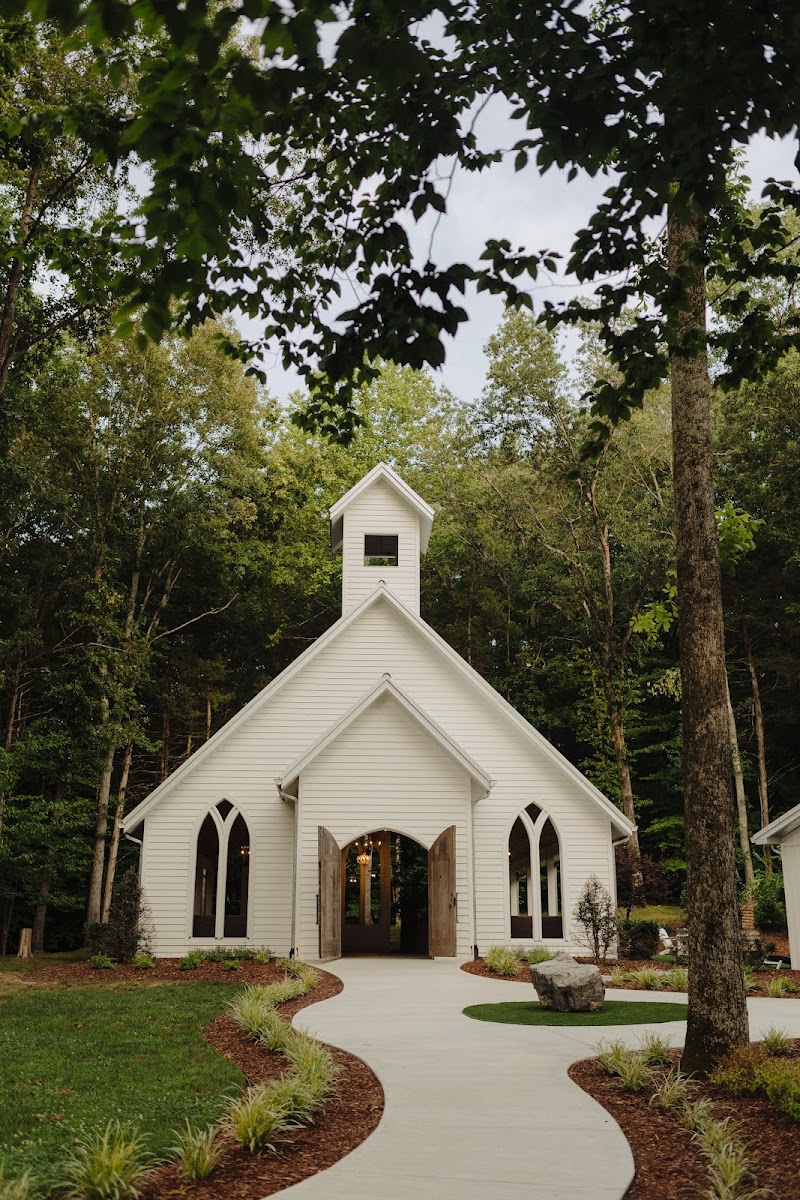
The drive west from Nashville unwinds in the way Tennessee back roads do — suburbs thinning to horse farms, then pastureland rolling toward the tree line. Big Bartons Creek Road curves through it all, and then a hand-painted sign announces Firefly Lane, and you turn onto a gravel lane that feels like it’s leading somewhere intentional. The property reveals itself slowly: first the woods pressing close on both sides, then an opening where the fields begin, and finally the buildings themselves — a bright white chapel perched at the edge of the forest like something out of a storybook, and behind it, the long, low profile of a matte-black barn that looks like it belongs in a design magazine, not the Tennessee countryside. This contrast — the traditional and the modern, the pastoral and the architectural — is what makes Firefly Lane Chapel so compelling as a wedding venue. It doesn’t ask you to choose between rustic charm and contemporary elegance. It offers both, on 85 acres of wooded hills and open meadows, just far enough from Nashville to feel like an escape but close enough that your grandmother won’t complain about the drive. Poppy has received 23 inquiries from couples planning Firefly Lane Chapel weddings, and while we haven’t yet designed flowers here, we’ve studied the spaces carefully. This is a venue that rewards thoughtful floral design — spaces that beg for drama, backdrops that demand restraint, and enough architectural variety that no two weddings need look alike.
About Firefly Lane Chapel
Firefly Lane Chapel is not, strictly speaking, just a chapel. It is a multi-venue property that happens to include one of the most photogenic open-air chapels in Middle Tennessee, along with a glass-walled reception hall, a modern black barn, two outdoor ceremony sites, and a three-bedroom farmhouse for getting ready or weekend accommodations. The property spans 85 acres of mixed woodland and pasture in Dickson, Tennessee, about 40 minutes west of downtown Nashville via I-40. The drive from Nashville International Airport takes roughly 45 minutes, which makes Firefly Lane accessible for destination weddings without feeling suburban or overdeveloped. The surrounding area is agricultural — cattle farms, hay fields, the occasional roadside produce stand — and the venue itself sits well off the main road, buffered by trees and elevation changes that create a sense of seclusion.
The Chapel itself, which gives the property its name, was purpose-built as a wedding venue and completed within the last several years. It is not a converted historic structure, which means the design is intentional and modern rather than adaptive reuse. The open-air concept is unusual: the chapel has walls, a roof, handcrafted wooden pews, and a traditional arched entrance, but where you would expect solid walls with small windows, there are instead massive open window frames that look directly into the surrounding forest. The effect is that of standing inside a structure while feeling almost outdoors, protected from rain but open to breeze, birdsong, and the movement of leaves. The walls are painted white, the ceiling is clad in honey-toned tongue-and-groove wood, and vintage-style lanterns hang at intervals down the central aisle. It is charming in the way that new buildings rarely manage to be — deliberate but not precious, photogenic but not contrived.
The Chapel Reception Hall, adjacent to the ceremony space, is its architectural opposite: 3,600 square feet of glass walls and clean modern lines. The entire perimeter is transparent, which floods the space with natural light and provides 360-degree views of the surrounding landscape. A covered patio extends from the reception hall, offering additional space for cocktails or late-night dancing under the stars. The Glass Hall is climate-controlled, which matters more than it might seem — Middle Tennessee in July or January requires HVAC, and an open-air barn is charming until your guests are sweating through their suits or shivering through dinner.
A short golf cart ride away (the property provides carts for guest transport and photography sessions), the Barn at Firefly Lane offers a completely different aesthetic. This is a 4,000-square-foot reception space painted matte black inside and out, with a contemporary rather than rustic design vocabulary. The dark walls create a dramatic backdrop that makes bright florals and candlelight pop in ways that light-colored barns simply cannot match. The Barn also has its own covered patio and can accommodate up to 200 guests for a seated dinner, making it the largest reception option on the property.
For outdoor ceremonies, Firefly Lane offers two distinct sites: The Enchanted Forest, a wooded clearing with a natural tree canopy and soft forest floor, and The Garden, an open field site with pastoral views and fewer trees. Both are part of the Barn wedding package, giving couples flexibility depending on weather, season, and aesthetic preference.
The Farmhouse, a three-bedroom residence on the property, sleeps up to ten guests and serves as the primary getting-ready location. It is a practical, comfortable space — not a showpiece, but perfectly functional for hair and makeup, champagne toasts, and bridal party preparations.
Logistically, Firefly Lane operates on a 13-hour rental window from 10 a.m. to 11 p.m., with vendor load-out scheduled between 10 and 11 p.m. Music must end at 10 p.m., which is a firm noise restriction common in rural Tennessee venues. The property requires a $1 million day-of liability insurance policy (available for around $176) and a $750 refundable security deposit. If you’re serving alcohol — which you’re allowed to bring in yourselves — you must hire a bartender from their preferred vendor list and add Host Liquor Liability to your insurance. They also require an onsite security fee of $300. Catering is required but not provided; couples choose from a preferred vendor list or request approval for outside caterers. One charming detail: Firefly Lane maintains a collection of leftover decor from previous weddings and offers it to current couples free of charge, which can meaningfully reduce rental costs for items like candles, vases, and signage.
For Poppy’s delivery and design teams, the venue’s location west of Nashville means a straightforward drive on I-40, and the 13-hour rental window provides ample setup time. We appreciate venues that offer golf carts for load-in, and Firefly Lane’s multiple buildings mean we would coordinate closely with the couple about which spaces are being used and in what order, to stage installations efficiently.
Event Spaces & Floral Opportunities
The Chapel at Firefly Lane
Capacity: 150 seated
Setting: This is the signature space — a 1,700-square-foot open-air chapel with white walls, a vaulted tongue-and-groove wood ceiling, handcrafted wooden pews arranged in traditional rows, and the defining feature: large, open window frames instead of solid walls, offering unobstructed views into the surrounding forest. Vintage-style lanterns hang from the ceiling along the center aisle, and the entrance is marked by arched double doors. The altar end of the chapel is backed by forest rather than a solid wall, which means your ceremony backdrop is living, moving, seasonal, and completely beyond your control — in the best possible way.
Floral approach: The open-air design means your ceremony florals are competing with — or, more accurately, collaborating with — the forest itself. This is not a space that needs heavy floral decoration; it needs thoughtful punctuation. The ceremony arch is your primary opportunity, positioned at the altar where the forest view is most dramatic. We favor a large but airy asymmetrical arch — think 8 to 10 feet tall, constructed from foraged branches (sourced locally or from the property with permission) and dressed with clusters of white and cream blooms: Patience garden roses, Quicksand roses, white ranunculus, and trailing jasmine vine or smilax to echo the wildness of the woods behind. Avoid overly structured or symmetrical designs; the forest is organic, and your florals should feel like an extension of it, not a contradiction. For the aisle, restraint is key. Simple pew markers every third or fourth row — small bundles of eucalyptus, Italian ruscus, and a single bloom tied with silk ribbon — are sufficient. Alternatively, consider lining the aisle with potted ferns or moss-covered stones rather than cut florals, which nods to the woodland setting and can be reused or replanted after the event. The hanging lanterns are charming on their own, but if you want to elevate them, we can add delicate garlands of smilax or spiral eucalyptus wrapped loosely around the chains. The arched entrance doors are ideal for a fresh greenery wreath or garland — nothing overly formal, just a lush, loose arrangement that welcomes guests as they arrive. The wood ceiling is high enough to accommodate hanging installations if desired, though we generally recommend letting the existing lanterns and natural light do the work unless you’re planning an evening ceremony and want to add drama with suspended floral chandeliers.
The Chapel Reception Hall
Capacity: 150 seated
Setting: Adjacent to the Chapel, this 3,600-square-foot space is the architectural inverse of its rustic neighbor. The Reception Hall is contemporary, light-filled, and almost entirely transparent — panoramic glass walls on all sides provide views of the surrounding landscape, and the covered patio extends the usable space outdoors. The interior is climate-controlled, with neutral flooring and a clean, minimalist design that doesn’t compete with the views. The effect is airy, modern, and surprisingly versatile — the glass walls mean your floral choices are visible from outside, which creates an opportunity for your centerpieces to function as part of the overall landscape design.
Floral approach: The cardinal rule in glass-walled spaces is to enhance, not block, the views. This means your centerpiece height matters enormously. We recommend one of two strategies: go very low (6 to 8 inches max) with lush, garden-style compote arrangements that sit below eye level, or go very tall (24+ inches) with elevated designs on clear acrylic or glass risers that lift the florals above sightlines entirely. For low arrangements, consider soft, overflowing designs in muted ceramic or stone compotes: Keira garden roses, Quicksand roses, white lisianthus, blush ranunculus, café au lait dahlias (in season), and plenty of textured foliage like eucalyptus, Italian ruscus, and trailing jasmine vine. These should feel abundant but natural, as if you gathered them from a cutting garden. For elevated designs, use tall, slender clear glass cylinders filled with submerged greenery or floating candles as the base, topped with a sphere or spray of flowers that sits high above the table. This approach keeps the tabletop visually light and unobstructed while still delivering floral impact. The glass walls create beautiful opportunities for hanging installations — a long garland of greenery and blooms suspended above the head table or dance floor will reflect in the glass at night, creating a layered, dimensional effect. The covered patio requires its own floral attention: cocktail tables should have small bud vase arrangements or single stems in glass bottles, and the transition from indoor to outdoor is an ideal spot for a larger urn arrangement or potted trees that tie the two spaces together visually. Because the Reception Hall connects to the Chapel, consider carrying through a unifying floral element — perhaps the same pew marker bundles reappear as napkin wraps or chair ties at dinner — to create a cohesive narrative between ceremony and reception.
The Barn at Firefly Lane
Capacity: 200 seated
Setting: This is the property’s largest and most dramatic reception space — a 4,000-square-foot modern barn painted matte black inside and out. The dark walls, dark ceiling, and contemporary design create a moody, gallery-like interior that feels more Brooklyn than rural Tennessee. The Barn is climate-controlled, with its own covered patio, and the sheer scale of the space allows for large guest counts and ambitious design installations. The black backdrop is unforgiving in one sense — empty tables or sparse decor will look stark — but it is extraordinarily flattering to bold florals, candlelight, and anything you want to stand out.
Floral approach: The black barn is your permission slip to go big, bold, and saturated. This is not a space for whisper-soft pastels or minimalist greenery installations; it wants color, drama, and abundance. Consider a palette of deep jewel tones: burgundy dahlias (Tartan, Black Satin), fuchsia garden roses (Yves Piaget, Piano), burnt orange ranunculus, magenta anemones, and coral charm peonies (in season), punctuated by unexpected accents like dark scabiosa pods, burgundy amaranthus, or even spray-painted magnolia leaves in metallic copper. Alternatively, lean into a high-contrast monochromatic scheme: all-white florals against the black walls create a striking, editorial effect — think white phalaenopsis orchids, white majolica spray roses, white hydrangea, white lisianthus, and white dinner plate dahlias in tall, sculptural arrangements. For centerpieces, consider elevated designs on gold or brass stands, or tall tapered arrangements in matte black vessels that echo the walls. The dark interior also makes candlelight essential — pillar candles, taper candles, and votives should be abundant on every table to add warmth and prevent the space from feeling cold. The Barn’s high ceilings allow for suspended installations, and here we recommend going full maximalist: a large-scale floral chandelier above the dance floor or a long, trailing garland installation above the head table will create a focal point and anchor the room. The covered patio should mirror the indoor floral intensity but in a slightly looser, more organic style to bridge the transition from the architectural interior to the natural landscape outside.
The Enchanted Forest
Setting: This is one of two outdoor ceremony sites available with a Barn wedding package. The Enchanted Forest is exactly what it sounds like: a wooded clearing nestled among mature trees, with a natural canopy overhead and a soft, leaf-covered forest floor underfoot. The tree trunks create natural aisle boundaries, and the dappled light filtering through the leaves shifts throughout the day. It is quiet, secluded, and deeply romantic — the kind of place where you half expect woodland creatures to serve as witnesses.
Floral approach: The forest does not need you to decorate it. What it needs is enhancement, not transformation. The ceremony arch should feel like it grew there: a structure built from branches and logs (ideally foraged locally), with florals woven through in a loose, organic style. Think wild and slightly untamed — white foxglove, blush astilbe, garden roses in soft peach and cream (Juliet, Patience, Keira), hellebores, ferns, and trailing ivy or smilax that drips and cascades asymmetrically. Avoid anything too structured or symmetrical; the forest itself is irregular, and your florals should echo that. For the aisle, consider natural markers: potted ferns, moss-covered stumps with lanterns, or simple stakes wrapped in greenery and tied with ribbon. If you want a more floral-forward aisle treatment, loose bundles of wildflowers and greenery tied to the trees every 10 feet will mark the path without overwhelming the setting. Hanging installations are possible if the tree branches are sturdy enough — small floral chandeliers or wreaths suspended at varying heights can add verticality and romance — but check with the venue first and use soft ties that won’t damage the bark. The forest floor is uneven, so make sure your floral structures are stable, and if the ceremony is in spring or after rain, plan for muddy conditions. The Enchanted Forest is ideal for couples who want a ceremony that feels private, intimate, and deeply connected to nature, and the floral design should honor that intention.
The Garden
Setting: The second outdoor ceremony option at the Barn, The Garden, is the Enchanted Forest’s opposite: an open field site with expansive views, minimal tree cover, and a pastoral, sunlit quality. The landscape is gentle and rolling, with grasses, wildflowers, and long sightlines to the surrounding countryside. Where the forest feels enclosed and intimate, the garden feels open and celebratory.
Floral approach: In an open field, your ceremony structure is the only vertical element, so it needs to be substantial. A large, freestanding floral arch or arbor — think 8 to 10 feet wide and equally tall — will anchor the ceremony and provide a focal point visible from a distance. This is the place for abundance: a fully dressed arch with garden roses (David Austin varieties like Patience, Juliet, and Constance), lisianthus, hydrangea, delphinium, and trailing amaranthus or jasmine vine, with plenty of greenery like Italian ruscus, seeded eucalyptus, and olive branches to add movement and texture. The palette can be softer here than in the forest — blush, ivory, soft peach, and dusty lavender work beautifully in open sunlight. For the aisle, consider low urn arrangements on either side of the ceremony space, or a petal-strewn aisle for simplicity. If the ceremony is on the hillside with a view behind the arch, keep the back of the arch less dense so guests can still see the landscape. If the view is behind the guests, you can go fuller and more opaque. The open setting also means weather is a bigger factor than in the forest — wind can topple arrangements, and full sun can wilt delicate blooms quickly, so choose sturdy flowers and secure your structures well. The Garden is ideal for couples who want a bright, romantic, pastoral ceremony with plenty of natural light for photography.
The Farmhouse
Capacity: 10 overnight guests
Setting: A three-bedroom, two-bathroom residence on the property, used primarily as a getting-ready space and available for overnight accommodations. It is functional and comfortable — a real house, not a styled bridal suite — with kitchen, living areas, and enough space for a bridal party to spread out.
Floral approach: The Farmhouse doesn’t need extensive floral design, but small, intentional touches go a long way. A bridal bouquet placed in a simple vase on the dresser or vanity creates a beautiful focal point for getting-ready photos. Consider a small arrangement for the breakfast table if you’re hosting a morning gathering — something simple and cheerful, like white hydrangea, blush spray roses, and eucalyptus in a ceramic pitcher. If hair and makeup are happening here, place small bud vases with single stems (garden roses, lisianthus, or ranunculus) in the bathroom and getting-ready area to add life and color to the space. A loose, unstructured bouquet of seasonal blooms on the kitchen counter or mantelpiece adds warmth and makes the space feel more special. These arrangements can often be repurposed later — moved to the reception hall bar or gift table — so they serve double duty and maximize your floral budget. The Farmhouse is also a good place for any extra greenery or flowers left over from ceremony setup, so if you’re working with a florist, ask them to use this space as a staging area for arrangements that will be moved later.
Wedding Flower Ideas for Firefly Lane Chapel
Wildwood Reverie
This concept leans fully into the property’s woodland character, embracing organic textures, foraged elements, and a palette drawn from the forest floor. It works beautifully in the Enchanted Forest ceremony site or as a grounding, natural counterpoint in the glass-walled Reception Hall.
The palette is muted and earthy: ivory, champagne, soft taupe, moss green, and touches of blush. Flowers include Patience garden roses, Quicksand roses (that perfect beige-taupe tone), white ranunculus, blush astilbe, hellebores, scabiosa in both bloom and pod form, and white foxglove for vertical interest. Foliage is abundant: Italian ruscus, seeded eucalyptus, olive branches, ferns, and trailing smilax or ivy. Textural accents include birch branches, pussy willow, dried grasses, and moss-covered stones or wood rounds used as risers.
Arrangements sit in natural, unpolished vessels: weathered wooden boxes, birch bark-wrapped containers, ceramic crocks in cream or gray, or even hollowed-out logs for ceremony installations. The ceremony arch is constructed from foraged branches (responsibly sourced with landowner permission) and dressed with loose, asymmetrical clusters of the above blooms, with smilax and ivy trailing down the sides. Centerpieces are low and lush, mounded in compotes or wooden boxes, with moss tucked around the base and trailing greenery spilling onto the table. Bouquets are loose and hand-tied with silk or linen ribbon, looking more like something gathered on a walk than something ordered from a florist. This is the concept for couples who want their flowers to feel like they belong to the landscape, not imposed upon it.
Modern Romance at Midnight
This concept is designed specifically for the black Barn — a dramatic, high-contrast palette that uses the dark walls to amplify bold, saturated color and graphic form. It is romantic but not soft, contemporary but not cold.
The palette centers on deep jewel tones with unexpected brights: burgundy, plum, fuchsia, burnt orange, and magenta, punctuated by blush and ivory to prevent it from feeling too dark. Flowers include Black Satin dahlias, burgundy ranunculus, Yves Piaget garden roses (that almost neon fuchsia), plum-colored hellebores, burgundy amaranthus, coral charm peonies (in season), magenta anemones, and white majolica spray roses for contrast. Foliage is rich and textured: dark burgundy oak leaves, copper-sprayed magnolia, burgundy eucalyptus, and olive branches.
Vessels are metallic and modern: brass compotes, matte black ceramic cylinders, gold geometric stands for elevated arrangements, and clear glass votives clustered in groups of five or seven. Centerpieces are either low and densely packed with blooms in brass compotes, or elevated on tall gold stands with cascading amaranthus and trailing jasmine. The head table gets a long, lush garland installation — flowers and greenery densely packed and running the full length of the table, interrupted by clusters of taper candles in varying heights. The ceremony arch (if used indoors in the Barn for a backup plan) is fully dressed and symmetrical, a departure from the organic woodland style, with blooms tightly packed in an ombre gradient from burgundy to blush. This concept is for couples who want drama, impact, and a look that feels more fashion-forward than farmhouse.
Glass and Garden
This concept is tailored for the Chapel Reception Hall and leans into the transparency of the space with light, airy arrangements that work with, not against, the glass walls and natural views. It is soft, romantic, and classic without being traditional.
The palette is gentle and luminous: ivory, champagne, blush, soft peach, and pale lavender, with plenty of green to tie it to the landscape outside. Flowers include Keira garden roses, Quicksand roses, white lisianthus, blush ranunculus, café au lait dahlias (in season), white sweet peas, blush astilbe, and pale lavender delphinium. Foliage is soft and loose: Italian ruscus, seeded eucalyptus, olive branches, and trailing jasmine vine or smilax.
Vessels are either very low (stone or ceramic compotes in soft gray or cream) or elevated on clear glass or acrylic risers. Low centerpieces are lush and garden-inspired, mounded and overflowing with blooms and trailing greenery. Elevated centerpieces use tall, slender glass cylinders as bases (filled with submerged greenery or floating candles) topped with a sphere of flowers that sits above eye level, leaving the table visually light. The head table features a long, low runner of florals and greenery, dense in the center and tapering at the ends, with pillar candles interspersed. A suspended installation — a 15- to 20-foot garland of greenery and blooms — hangs above the dance floor, reflecting in the glass walls at night. The cocktail patio gets small arrangements in clear glass bottles or bud vases, and the entrance to the Reception Hall is marked by a pair of large urns overflowing with the same soft palette. This concept is for couples who want elegance and romance without heaviness, and who trust that sometimes the most sophisticated choice is to let the architecture breathe.
Seasonal Considerations
Middle Tennessee experiences four true seasons, and each brings distinct opportunities and challenges for wedding flowers at Firefly Lane Chapel.
Spring (March – May): Spring in Dickson is gentle and green, with temperatures ranging from the 50s to the 70s and unpredictable rain. This is when the woods wake up — wildflowers bloom on the forest floor, trees leaf out, and the landscape turns from brown to vivid green seemingly overnight. Locally, you’ll see dogwood and redbud trees blooming, and the Enchanted Forest ceremony site is particularly magical in April and May. For florals, spring is tulip season, ranunculus season, and the beginning of peony season (late April into May). Hellebores, anemones, sweet peas, and foxglove are also available. Spring weddings at Firefly Lane should lean into the freshness of the season: soft palettes, lots of greenery, and garden-style arrangements that echo the renewal happening outside. Weather-wise, plan for possible rain (the Chapel’s open-air design provides some cover, but the outdoor ceremony sites will need a tent backup) and muddy ground conditions, especially in the Enchanted Forest. Pollen can also be an issue for guests with allergies, so have tissues and antihistamines on hand. Best months: Late April and May, when temperatures are warm but not hot and peonies are in season.
Summer (June – August): Summer in Tennessee is hot, humid, and lush. Temperatures regularly reach the upper 80s and 90s, with high humidity that makes it feel even warmer. Afternoon thunderstorms are common, especially in July and August, and the sun is intense in open spaces like The Garden. The upside: the landscape is at its most verdant, and locally grown flowers are abundant. Hydrangeas (both fresh and dried), garden roses, zinnias, sunflowers, and dahlias are all in season. Lisianthus, spray roses, and many foliage varieties thrive in summer. The downside: heat-sensitive flowers like peonies and sweet peas are unavailable, and delicate blooms can wilt quickly in the heat. For summer weddings at Firefly Lane, choose hardy, heat-tolerant flowers and keep arrangements out of direct sun as much as possible. The climate-controlled Chapel Reception Hall and Barn are ideal for summer celebrations, while outdoor ceremonies should be scheduled for late afternoon or early evening when temperatures drop. Hydration stations for guests are essential, and any florals placed outside should be misted and shaded until the last possible moment. Best months: June (before peak heat) and late September (technically still summer but cooling off).
Fall (September – November): Fall is peak wedding season in Tennessee, and for good reason. The heat breaks, the humidity drops, and the foliage begins its slow transformation to gold, orange, and crimson. Temperatures range from the 60s to the 70s in September and October, cooling into the 50s and 60s in November. The light is extraordinary — that particular slant of autumn sun that turns everything amber. The woods surrounding the Chapel and the open fields near The Garden are at their most photogenic. For florals, fall brings dahlias at their peak (dozens of varieties in every color), garden roses, marigolds, chrysanthemums, and the return of ranunculus as temperatures cool. Foliage takes center stage: copper beech, oak leaves, pampas grass, and ornamental grasses add texture and movement. Fall weddings at Firefly Lane can embrace either the traditional autumn palette (burgundy, burnt orange, rust, gold) or go against the grain with jewel tones or even pastels for contrast. The weather is generally reliable, though November can bring early cold snaps. The Enchanted Forest ceremony site is stunning when the leaves turn, and the open-air Chapel benefits from the cooler temperatures. Best months: October, hands down — perfect weather, peak foliage, and reliable conditions.
Winter (December – February): Winter in Dickson is