
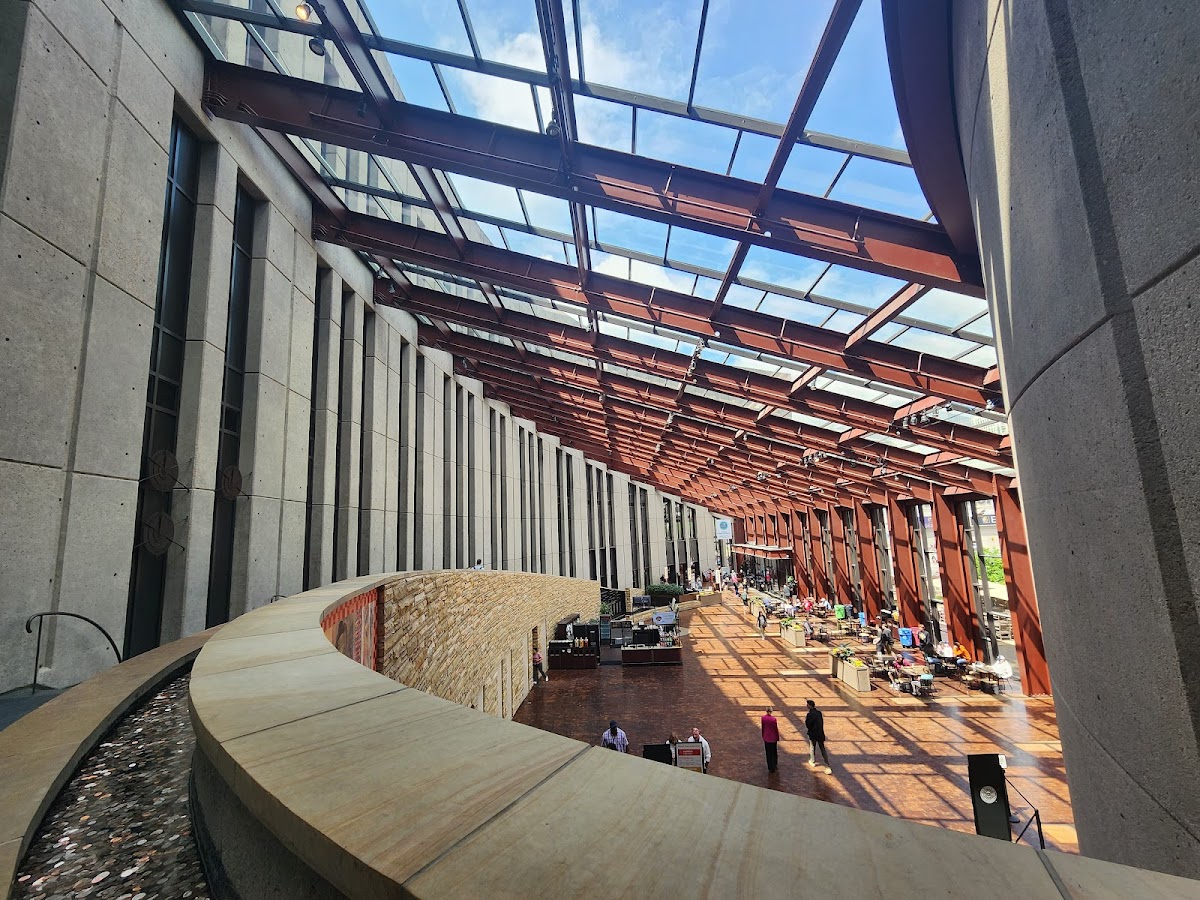
You approach from Rep. John Lewis Way, and the first thing you register is the building’s unusual geometry — not a box, not a conventional museum structure, but something more dynamic. The Country Music Hall of Fame and Museum announces itself with architectural confidence: a wedge-shaped tower that rises like a bass clef staff, curves and angles that suggest rhythm and movement, and a facade that catches the light differently depending on the hour. This is not accidental. This is intentional design in a city where everything means something. You pass through the entrance, and suddenly you’re standing in the Hall of Fame Rotunda, surrounded by bronze plaques honoring legends — Johnny Cash, Dolly Parton, Patsy Cline — their names forming an unbroken circle that feels almost sacred. Then the space opens up: the Event Hall with its forty-foot glass wall framing downtown Nashville like a living postcard, the Batman Building standing sentinel in the distance. The venue reveals itself in layers — intimate theaters, sun-drenched conservatories, outdoor terraces where the city hum becomes ambient music. Poppy has received seven inquiries for Country Music Hall of Fame and Museum wedding flowers, and each conversation begins the same way: couples trying to articulate what it feels like to get married in a place where American music history is not just displayed but actively honored, where the architecture itself tells stories, where every room offers a different stage for their celebration.
About Country Music Hall of Fame and Museum
The Country Music Hall of Fame and Museum sits at 222 Rep. John Lewis Way South in Nashville’s SoBro (South of Broadway) district, one block off the neon-lit chaos of Lower Broadway but feeling worlds away. The building opened in 2001 as part of Nashville’s downtown revitalization, designed by architectural firm Tuck Hinton to embody the physicality of country music itself. The tower’s windows are angled like piano keys. The sweeping curves reference the Fifties tailfins of Cadillacs that carried musicians between honky-tonks and recording studios. The copper-colored metal siding evokes the rich patina of a vintage guitar. This is architecture as narrative, and for a wedding, that narrative becomes part of your story. You are not just renting a room. You are stepping into a building that was conceived as a love letter to American roots music, and that intentionality translates into an event that feels significant, textured, and unmistakably Nashville.
The museum’s collection spans over 2.5 million artifacts — costumes worn by legends, handwritten lyrics, instruments that shaped genres, photographs that captured cultural turning points. For weddings, particularly full buyouts, this means your guests move through spaces where Elvis Presley’s gold Cadillac sits behind glass, where Hank Williams’ handwritten lyrics are preserved under archival lighting, where the Taylor Swift Education Center connects contemporary stardom to the genre’s deep roots. It is an unusual backdrop for a celebration, and it works precisely because it is unusual. Your guests are not just attending a wedding. They are experiencing a venue that exists nowhere else, in a city that claims country music as its birthright.
The venue’s events program is managed by an in-house team with deep institutional knowledge. They have coordinated everything from intimate 50-person rehearsal dinners in Wild Boar Hall (a misnomer — there is no Wild Boar Hall here, though the BMI Hall boardroom offers similar intimacy) to 600-guest galas in the Event Hall. Catering is handled exclusively by the venue’s culinary team, which means streamlined communication but also less flexibility for couples with specific vendor relationships. The approved vendor list includes preferred parking services through Trinity Parking, which matters in downtown Nashville where parking can be a logistical headache. For Nashville wedding florists like Poppy, the venue is accessible and accommodating. Load-in occurs through a dedicated service entrance, and the events team provides clear timelines, floor plans, and installation guidelines. The hardwood floors in the Event Hall require careful placement of heavy urns and pedestals — floor protection is non-negotiable — and the museum’s strict insurance requirements mean your florist needs comprehensive liability coverage and experience working in institutional settings.
Logistically, the Hall of Fame is a 10-minute drive from East Nashville’s design studios, 15 minutes from the Gulch’s high-rises, and walking distance from dozens of hotels where out-of-town guests will likely stay. The surrounding SoBro neighborhood offers pre- and post-wedding activities — rooftop bars, live music venues, the Ascend Amphitheater along the riverfront — that turn a single-day celebration into a full weekend experience. For couples planning destination weddings, this centrality is invaluable. Your guests can experience Nashville authentically without needing rental cars or complicated navigation.
Event Spaces & Floral Opportunities
Event Hall with Carlton Family Terrace
Capacity: 648 seated, 600 reception-style, 900 theater-style
Setting: The Event Hall is the venue’s showpiece — 10,000 square feet of open, flexible space with hardwood floors in a warm honey tone, exposed ductwork painted matte black for an industrial edge, and that extraordinary wall of glass. The windows face southwest, which means late afternoon light floods the room in amber and gold, and evening receptions look out onto Nashville’s illuminated skyline. The adjacent Carlton Family Terrace extends the space outdoors, offering an elevated view above the street with planters, bistro lighting options, and enough room for cocktail hour or a ceremonial first look. The HCA Lobby serves as a natural pre-function area, and tucked-away green rooms provide private spaces for the wedding party. The architecture here is deliberately neutral — this is a blank canvas venue that lets your design vision take center stage.
Floral approach: With a room this large, the risk is creating floral moments that get lost in the volume. We recommend anchoring the space with substantial installations that create visual weight without overwhelming sightlines to those windows. For guest tables, consider elevated centerpieces on 24- or 30-inch gold stands topped with loose, organic arrangements of Juliet garden roses, Quicksand roses, peach stock, white majolica spray roses, and trailing jasmine vine. The elevation keeps florals above eye level so guests can converse across tables while the skyline remains visible. Alternatively, very low, sprawling centerpieces in hammered brass compotes — mounded with Café au Lait dahlias, apricot ranunculus, white lisianthus, and Italian ruscus — create lushness without height. The entry to the Event Hall begs for a statement: a pair of 6-foot floral columns flanking the doorway, constructed on natural wood pedestals and overflowing with seasonal branches (dogwood in spring, magnolia foliage in summer, copper beech in fall, curly willow in winter), garden roses, and cascading amaranthus. On the Carlton Terrace, we love using large ceramic planters filled with flowing arrangements of café au lait dahlias, white hydrangea, blush roses, and eucalyptus that feel like elevated garden urns. The outdoor space allows for weatherproof installations — consider a floral installation wrapping the terrace railing with smilax garland, clusters of roses, and votives in hurricane glasses. The skyline backdrop is the room’s best feature; Country Music Hall of Fame and Museum wedding flowers should frame it, not compete with it.
Mike Curb Conservatory and Curb Records Courtyard
Capacity: 360 seated, 500 reception-style
Setting: The Curb Conservatory was architecturally conceived to evoke the “front porch” origins of country music — the informal, communal spaces where neighbors gathered to play instruments and share songs. The design leans into that warmth with wood tones, glass walls that blur the line between interior and exterior, and direct access to the Curb Records Courtyard, an outdoor space with planters, stone pavers, and string lighting infrastructure. This is a space that feels both polished and approachable, sophisticated without being stuffy. It works beautifully for ceremonies, smaller receptions, or as a cocktail hour transition space when paired with other rooms.
Floral approach: The “front porch” aesthetic calls for Southern garden florals with a refined edge. Think arrangements that look gathered from a cutting garden rather than rigidly composed. We favor ceramic vessels in soft white or pale blue — the kind your grandmother might have kept on her porch — filled with overflowing arrangements of white hydrangea, peach Juliet roses, blush ranunculus, scabiosa, white sweet peas (when available in spring), and trailing sprigs of eucalyptus and jasmine vine. For the Courtyard, consider using wooden apple crates or galvanized metal buckets as vessels for larger installations near the entrance. Line the pathway from the Conservatory to the Courtyard with a series of lanterns surrounded by low floral collars of seeded eucalyptus, white spray roses, and dusty miller. If holding a ceremony here, a wooden arbor softened with fabric draping and floral clusters at each corner — using magnolia branches (a nod to Tennessee’s state tree, though not the official state flower), blush roses, and lush greenery — creates an organic, romantic focal point. For cocktail tables, simple arrangements in mint julep cups or mason jars with single-variety blooms (all white roses, all peach ranunculus, all ivory lisianthus) feel appropriately casual and charming. The glass walls mean natural light is abundant, so florals photograph beautifully without additional uplighting. This is a space where less-is-more restraint actually amplifies the design impact.
Hall of Fame Rotunda
Capacity: Varies based on setup; typically used for ceremonies or cocktails, not seated dinners
Setting: The Hall of Fame Rotunda is the emotional and architectural center of the entire building. Bronze plaques encircle the space at eye level, each one commemorating a country music legend. The circle is unbroken — a symbolic gesture representing the continuity of the genre and the interconnectedness of its artists. Above, a domed ceiling with clerestory windows filters natural light down onto the plaques, creating an almost reverential quality to the space. The floor is polished stone in warm taupe tones. The walls curve, creating acoustic warmth. This is not a space that needs decoration. It is already complete. For couples seeking a ceremony location with gravitas and meaning, the Rotunda delivers.
Floral approach: Here, the cardinal rule is restraint. The bronze plaques, the architectural geometry, the historical weight — these are the design elements. Country Music Hall of Fame and Museum wedding flowers in this space should enhance, not distract. We recommend focusing florals at the ceremony’s functional points rather than attempting to fill the room. For the aisle, consider a simple white fabric runner lined with low arrangements every third or fourth row — small clusters of white garden roses, white ranunculus, and seeded eucalyptus in mercury glass votives or shallow bronze bowls that echo the plaques’ metallic finish. At the ceremony focal point (typically where the officiant stands), a pair of tall, slender arrangements on bronze or gold stands — constructed with white phalaenopsis orchids, white calla lilies, and trailing Italian ruscus — creates vertical elegance without overwhelming the space. Avoid wide, sprawling arrangements that block views of the plaques; this space is about honoring what already exists. For cocktail hour in the Rotunda, small arrangements on high-tops in simple clear glass cylinders with white blooms (roses, lisianthus, tulips) keep things elegant and unobtrusive. If the couple wishes to make a statement, a single large wreath — constructed on a grapevine base with white hydrangea, white roses, and greenery — can be mounted on the entrance door as guests arrive, offering a welcoming floral gesture that respects the space’s solemnity.
BMI Hall (Bud Wendell & Steve Turner Boardroom)
Capacity: 108 seated, 80 reception-style, 120 theater-style
Setting: Located on the fourth floor, the BMI Hall is an intimate, elegant boardroom with cherry wood paneling that glows warm and rich under ambient lighting. The room feels executive, refined, and intentionally smaller-scale — perfect for rehearsal dinners, intimate weddings, or pre-ceremony gatherings. Large windows provide natural light and views of the surrounding cityscape. The built-in woodwork gives the space architectural character, so floral design here should complement rather than compete with the existing warmth.
Floral approach: Cherry wood paneling pairs beautifully with deep, jewel-toned florals. Consider centerpieces in low brass or copper vessels filled with burgundy dahlias (Black Satin, Karma Choc), deep plum calla lilies, chocolate cosmos, burgundy carnations (underrated and stunning when used intentionally), and dark foliage like burgundy leucadendron or smoke bush. The effect is moody, sophisticated, and rich without feeling heavy. For a lighter approach, cream and peach tones — Patience garden roses, Juliet roses, peach stock, white majolica spray roses, and seeded eucalyptus — create warmth that echoes the cherry wood without adding visual weight. The boardroom table itself can support a continuous garland installation running the length of the table: a base of smilax or Italian ruscus garland punctuated every 18 inches with clusters of roses, ranunculus, and votives in amber glass holders. This creates a lush, connected look that encourages conversation across the table. For a cocktail-style event, arrangements on credenzas and side tables in varying heights (using books or risers underneath) create visual interest and allow guests to move through the space without obstruction. This is a room where intimate, detailed florals — the kind guests can lean in to admire — work better than large-scale installations.
CMA Theater and James Lowak Grand Foyer
Capacity: 776 theater-style; stage accommodates 48-50 seated or standing
Setting: The CMA Theater is a state-of-the-art performance space with tiered seating, professional sound and lighting systems, and a stage large enough to host live performances or theatrical ceremonies. The James Lowak Grand Foyer serves as the pre-function area — a high-ceilinged, light-filled space with modern lines and ample room for cocktails, displays, or guest book tables. This combination of spaces works beautifully for couples who want a concert-style ceremony or a wedding that incorporates live music in a meaningful way.
Floral approach: The theater stage is an opportunity for dramatic, large-scale floral design. Consider a floral backdrop constructed on a freestanding frame — an 8-foot by 10-foot installation covered in smilax or silver dollar eucalyptus with clusters of white hydrangea, white roses, blush roses, and trailing jasmine vine woven throughout. This creates a lush, photo-ready focal point that works for ceremonies and provides a stunning backdrop for live performances if the couple incorporates musicians. Alternatively, a pair of tall floral columns flanking the stage — 7 feet tall, constructed on natural wood or metal frames, and filled with flowing arrangements of garden roses, stock, delphinium, and cascading amaranthus — creates symmetry and elegance. For the aisle in the theater seating, keep arrangements low and unobtrusive; theater seating creates sightline challenges, so anything over 12 inches tall will block views for guests. Simple arrangements at the end of each row — clusters of roses and eucalyptus tied with silk ribbon to the armrests — provide aisle definition without obstruction. In the Grand Foyer, large-scale arrangements on pedestals (using white phalaenopsis orchids, white calla lilies, white hydrangea, and curly willow branches for height) create impact in the vertical space and serve as wayfinding elements that guide guests from the foyer into the theater. The Foyer’s modern architecture pairs well with clean, architectural floral designs — think mono-chromatic palettes and strong geometric lines rather than loose, garden-style arrangements.
Ford Theater
Capacity: 213 theater-style; stage accommodates 50 seated or standing
Setting: The Ford Theater is smaller and more intimate than the CMA Theater, often described as the venue’s “living room” for its warm, approachable feel. The space retains professional sound and lighting capabilities but feels more personal, making it ideal for ceremonies, smaller receptions, or events where the couple wants guests to feel connected to the stage and to each other.
Floral approach: The living room metaphor should guide floral design here — think arrangements that feel comfortable, inviting, and warm rather than formal or grand. For the stage, consider a low, sprawling installation across a farm table or wooden bench: a runner of seeded eucalyptus and Italian ruscus with clusters of peach Juliet roses, ivory spray roses, white lisianthus, peach stock, and votives in amber glass scattered throughout. This creates a gathered, abundant look that feels intimate rather than theatrical. For aisle arrangements, mason jars or small ceramic vessels tied to chair armrests with twine or silk ribbon, filled with single-variety blooms (all white roses or all peach ranunculus), feel appropriate to the space’s casual elegance. If the couple is hosting a seated dinner on the stage, small bud vases down the center of the table — each with a single Juliet rose, a single ranunculus, or a single dahlia — create a collected, eclectic look that feels personal. In the seating area, small arrangements on side tables or ledges using warm-toned florals (peach, cream, soft yellow) and simple vessels keep the space feeling cozy without cluttering the sightlines.
Museum Buyout
Capacity: Varies — access to all 13 event spaces across the venue
Setting: A full museum buyout offers exclusive access to the entire Country Music Hall of Fame and Museum, including the Event Hall, both theaters, the Rotunda, the Conservatory, outdoor terraces, and all public galleries and exhibits. This is the ultimate Nashville wedding experience — guests can explore exhibits between courses, hold ceremonies in the Rotunda, cocktails on the Carlton Terrace, dinner in the Event Hall, and late-night dancing in the Conservatory. The logistical coordination is complex, but the result is a wedding that moves through space and time like a curated experience.
Floral approach: With access to 13 distinct spaces, the floral design challenge becomes creating cohesion without repetition. We recommend establishing a consistent floral palette and vessel style that appears in every space, but varying the scale and style of arrangements to suit each room’s architecture and function. For example: use garden roses, ranunculus, and eucalyptus throughout, but install low, lush centerpieces in the Event Hall, tall dramatic arrangements in the Grand Foyer, simple aisle clusters in the Rotunda, and garden-style urns in the Conservatory. This creates visual continuity that helps guests feel oriented as they move through the spaces, while each room retains its distinct character. Key installations should occur at transition points — the entrance from the street, the doorway between the Rotunda and Event Hall, the passage from indoor to Carlton Terrace — using large-scale arrangements or garlands that signal a shift in the evening’s progression. For a buyout, budget allocation matters: invest heavily in the Event Hall (where most guests will spend the majority of the evening) and the Rotunda (where the ceremony creates the emotional high point), and use simpler, more restrained florals in secondary spaces like hallways, green rooms, and smaller galleries. A buyout also allows for creative installations in unexpected places — floral arrangements near Elvis’s gold Cadillac, a garland installation along the grand staircase, or small bud vases placed throughout exhibit cases (with museum approval). These moments surprise and delight guests, turning the venue into a total immersive experience.
Wedding Flower Ideas for Country Music Hall of Fame and Museum
Skyline Serenade
This concept responds directly to the Event Hall’s most stunning feature: those floor-to-ceiling windows framing downtown Nashville. The palette is urban and sophisticated — whites, creams, soft grays, and metallic gold accents. Blooms include white phalaenopsis orchids, ivory garden roses (Patience, Purity), white ranunculus, white lisianthus, white sweet peas (in season), and silver dollar eucalyptus. Vessels are sleek and modern: clear glass cylinders in varying heights, brushed gold stands, and low rectangular troughs in matte white ceramic. The effect is clean, elegant, and intentionally minimal at eye level so nothing competes with the skyline. For elevated centerpieces, arrangements sit atop 30-inch gold stands and appear to float above the table, keeping the view unobstructed. For the Carlton Terrace, oversized white ceramic planters hold flowing arrangements of white hydrangea, white roses, and eucalyptus with trailing jasmine vine spilling over the edges. In the Rotunda ceremony, white orchid stems in tall clear glass cylinders flank the officiant, and the aisle is lined with simple white pillar candles in hurricane glass rather than elaborate floral clusters. This palette works year-round, photographs beautifully in both natural and artificial light, and feels distinctly Nashville-meets-Manhattan — cosmopolitan without losing warmth.
Southern Front Porch
This concept leans into the Curb Conservatory’s architectural intention and embraces Tennessee’s country roots with a garden-inspired, romantic palette. Colors include blush, peach, soft coral, cream, and abundant greenery. Flowers include Juliet garden roses, Patience garden roses, peach ranunculus, white hydrangea, peach stock, coral charm peonies (in season, April-May), white scabiosa, and lush foliage like seeded eucalyptus, Italian ruscus, and magnolia branches. Vessels are intentionally domestic and collected: white ceramic pitchers, pale blue stoneware crocks, galvanized metal buckets, wooden crates, and vintage glass bottles. Arrangements feel abundant and gathered, like something pulled from a grandmother’s cutting garden on a summer morning. For the Conservatory and Courtyard, larger installations use apple crates overflowing with blooms and greenery, with trailing jasmine vine spilling onto the ground. Guest tables feature low, mounded centerpieces in ceramic vessels that encourage guests to lean in and admire the texture and scent. The Rotunda ceremony uses magnolia branches as aisle markers — simple branches in brass stands with clusters of blush roses tied at the base. In the Event Hall, this palette softens the room’s industrial edge, creating warmth and nostalgia. This is Country Music Hall of Fame and Museum wedding flowers for couples who want to honor Nashville’s pastoral roots while celebrating in its urban heart.
Legends and Gold
This concept honors the Hall of Fame’s core identity — its celebration of music legends — with a rich, dramatic palette inspired by gold records, stage lights, and the glamour of classic country performances. Colors include deep burgundy, plum, gold, champagne, and cream. Blooms include burgundy dahlias (Rip City, Karma Choc), plum-toned calla lilies, deep red roses (Black Baccara, Explorer), champagne roses (Quicksand, Sahara), cream lisianthus, and chocolate cosmos. Foliage includes burgundy leucadendron, smoke bush, and bronze-toned croton leaves. Vessels are opulent: antique brass urns, gold compotes, bronze pedestals, and amber glass votives. The effect is moody, romantic, and unmistakably luxurious. In the Event Hall, tall arrangements on gold stands create drama without blocking the skyline views, and the deep tones photograph beautifully against the city lights at night. The Rotunda ceremony features bronze urns at the focal point, their metallic finish echoing the bronze plaques. In the BMI Hall, this palette feels perfectly at home against the cherry wood paneling, creating a cohesive warmth. For the CMA Theater stage, a large-scale installation using burgundy and gold tones creates a backdrop that feels like a vintage concert poster come to life. This is the palette for couples who want opulence, who want their wedding to feel like an event worthy of the legends surrounding them.
Seasonal Considerations
Nashville sits in USDA Hardiness Zone 7a, which means four distinct seasons with relatively mild winters and hot, humid summers. Understanding seasonal availability helps both with budget and design.
Spring (March through May) brings Nashville’s most dramatic floral abundance. Tulips, daffodils, hyacinths, anemones, and ranunculus are locally available and affordable. Peonies arrive in late April and peak in May — if your wedding falls during this window and peonies matter to you, build your budget around them because they are spectacular but expensive. Dogwood branches and cherry blossoms are available for large installations, adding vertical height and springtime romance. Weather in Nashville during spring is famously unpredictable — a sunny 75-degree day can be followed by a 50-degree rainstorm — so outdoor spaces like the Carlton Terrace require backup plans. May is peak wedding season in Nashville, and flower availability is abundant but demand is high, so early booking with your Nashville wedding florist ensures access to premium blooms.
Summer (June through August) in Nashville is hot and humid, with temperatures regularly exceeding 90 degrees and afternoon thunderstorms common. For events on the Carlton Terrace, heat-tolerant flowers are essential: sunflowers, zinnias, celosia, dahlias, and gladiolus hold up better than delicate garden roses or peonies. Hydrangeas thrive in Tennessee’s humidity and are locally grown throughout summer, making them affordable and abundant. We recommend avoiding outdoor ceremonies during peak afternoon heat (2 p.m. to 5 p.m.) and scheduling Carlton Terrace cocktail hours for early evening when temperatures drop. Inside the air-conditioned Event Hall or Conservatory, delicate blooms are fine, but anything placed outdoors for more than 30 minutes should be designed with heat endurance in mind. Summer also brings fireflies to Nashville — if your event extends onto the Carlton Terrace at dusk, the natural ambiance is magical and requires minimal additional lighting or decor.
Fall (September through November) is Nashville’s second peak wedding season, and for good reason. Temperatures cool into the 60s and 70s, humidity drops, and the light takes on that golden-hour quality that makes every photograph look like a movie still. Dahlias (Tennessee-grown) are at their peak, offering enormous blooms in every color imaginable. Marigolds, celosia, chrysanthemums, and sunflowers provide seasonal color. For foliage, sourced branches of oak, maple, and sweetgum in their fall colors add Tennessee-specific texture to large installations. October is the busiest wedding month in Nashville, so venue and florist availability tighten. The Event Hall’s skyline views are particularly stunning in fall when the setting sun bathes the downtown buildings in amber light. November can bring unpredictable cold snaps, so outdoor spaces should be contingency plans rather than primary event locations.
Winter (December through February) is Nashville’s quietest wedding season, but the Hall of Fame becomes especially magical during the holidays when the surrounding downtown is lit with seasonal displays. Winter florals include amaryllis, paperwhites, evergreen branches (magnolia, pine, cedar), holly berries, and forced bulbs like tulips and hyacinths imported from southern growing regions or hothouses. The color palette naturally shifts toward whites, creams, deep reds, and rich greens. Snow is rare in Nashville (perhaps once or twice per winter), but freezing rain and cold temperatures can create logistical challenges for outdoor setups. We recommend keeping all floral installations indoors and using the Carlton Terrace only if equipped with heat lamps and weather protection. The Event Hall’s glass walls frame the city lights beautifully during early-dark winter evenings, creating a cozy, urban ambiance. Winter also offers budget advantages: flower prices drop outside peak season, and venue availability increases, giving couples more flexibility with date selection and vendor booking.
Poppy’s Expert Take
The skyline is your co-designer, not your competition. The Event Hall’s 40-foot glass windows are the room’s best feature, and too many couples (and florists) make the mistake of trying to out-design them. Keep centerpieces either very low (under 12 inches) or elevated on tall stands (24 inches or higher) so the view remains unobstructed at eye level. During site visits, stand at a seated position and look toward the windows — if your centerpiece mock-up blocks the Batman Building or the Bridgestone Arena, it’s too tall. The skyline does not need floral framing. It needs floral accompaniment — arrangements that exist in harmony with the view, not in conflict with it.
The Hall of Fame Rotunda demands restraint. This is one of the few spaces where less truly is more. The bronze plaques honoring country music legends are the design element, and any floral installation that draws focus away from them underm