
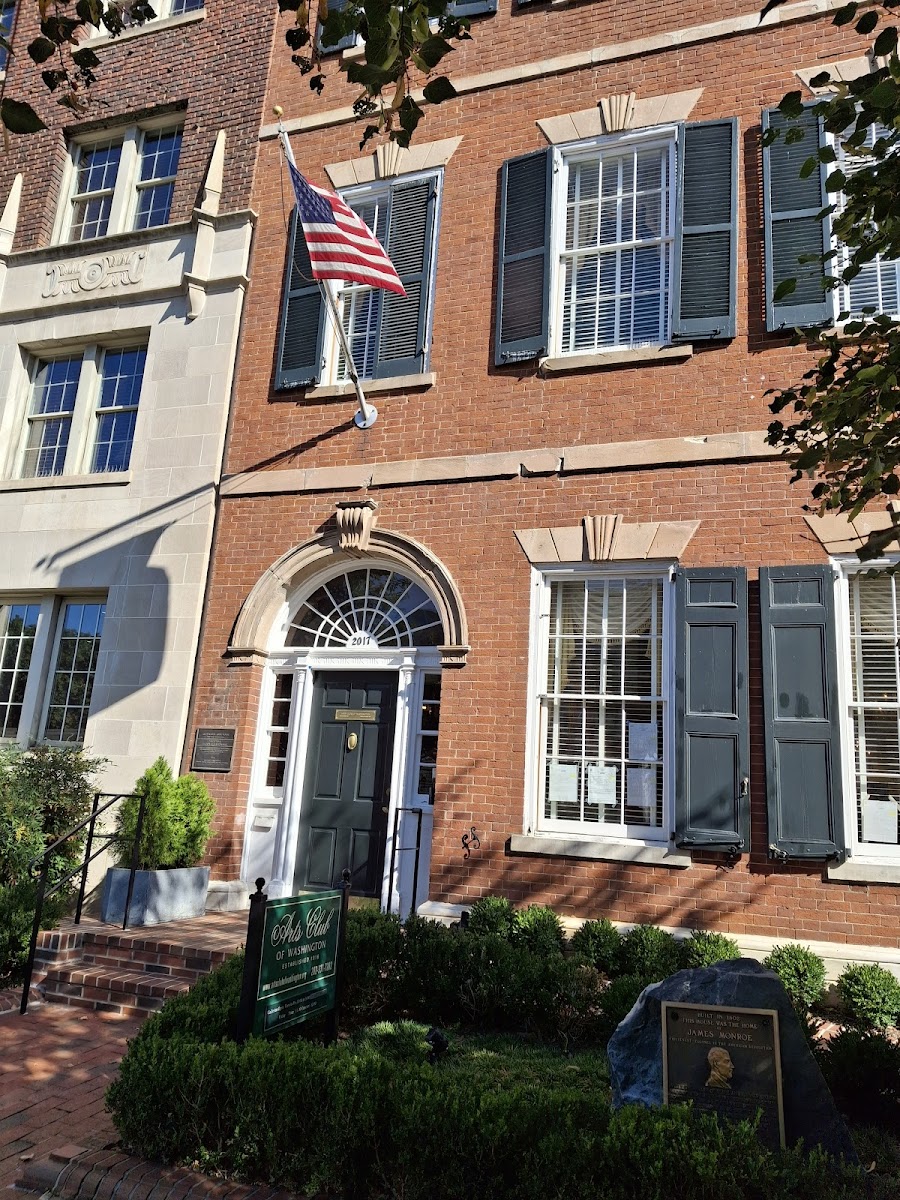
You turn off Pennsylvania Avenue onto I Street, the White House visible just blocks behind, and suddenly there it is: a four-story Beaux-Arts mansion that looks like it was transported intact from Paris’s Right Bank. The limestone facade rises pale and dignified between modern office buildings, carved door arches framing the entrance, iron balconies bracketing tall windows. Inside, the first thing you notice is the light — the way it pours through the Monroe Gallery’s floor-to-ceiling bay windows and catches on the crystal chandeliers suspended above the grand staircase. Then the art. A contemporary oil painting hangs above an eighteenth-century console. A glass sculpture catches afternoon sun on a marble pedestal. This is not a venue frozen in aspic, preserving a single historical moment. The Arts Club of Washington has been a living cultural institution since 1916, and the Monroe House — built in 1806 as one of Foggy Bottom’s earliest grand residences — has always existed in conversation between past and present. For weddings, this means something rare in Washington: a venue with genuine gravitas and architectural bones that also welcomes creative risk. Poppy has designed Arts Club of Washington wedding flowers here for couples who want sophistication without stuffiness, history without rigidity. It is a place where you can hang a Calder mobile in one gallery and say your vows beneath a Juliet rose installation on the stage of another, and somehow it all makes perfect sense.
About Arts Club of Washington (Monroe House)
The Monroe House predates most of what we now consider “historic Washington.” When it was built at 2017 I Street NW in 1806, this was the edge of the young capital city, a semi-rural neighborhood called Foggy Bottom for the mist that rose from the nearby Potomac marshes. The original structure was a modest Federal-style residence, but by the turn of the twentieth century, the house had been substantially expanded and reimagined in the fashionable Beaux-Arts style — the limestone exterior, the mansard roof, the elaborate ironwork, the sweeping interior staircase. In 1916, the Arts Club of Washington acquired the building and transformed it into a private club dedicated to fostering the arts, a mission it has maintained for over a century. Today, the club operates four gallery spaces within the mansion — the Monroe Gallery, MacFeely Gallery, Spilsbury Gallery, and smaller exhibition areas — hosting rotating exhibitions of contemporary painting, sculpture, photography, and installation art by both established and emerging artists.
What this means for a wedding is that the visual landscape is never static. When you tour the venue in January, there might be large-scale abstract canvases in bold primary colors lining the Monroe Gallery walls. Return in June, and you could find a series of delicate botanical watercolors. This rotating collection functions as part of your wedding design — sometimes as an asset (a stunning piece of artwork can anchor an entire color palette), sometimes as a constraint (you need to design around rather than over existing visual statements). Poppy has learned to request the exhibition schedule months in advance and to visit the venue close to the wedding date to see what’s actually on the walls. The Arts Club is refreshingly flexible about florals — they welcome outside designers, provide no restrictive decor policies beyond common sense (no damage to artwork or historic surfaces), and understand that flowers are themselves a form of artistic expression.
Architecturally, the Monroe House is a study in Gilded Age elegance. High ceilings throughout — fourteen feet on the main floors — with elaborate crown molding, carved door surrounds, and original hardwood floors. The color palette is refined: cream walls, warm wood tones, touches of gilt on frames and fixtures. The furniture is an eclectic mix of period antiques and contemporary pieces, all thoughtfully curated to feel collected rather than decorated. The venue is spread across four floors, with public rooms on the main level, galleries and salons on the second and third floors, and a theater space in the lower level. The private walled garden at the rear of the property is a true hidden gem — you would never guess from the street that behind the mansion lies a slate-and-brick patio surrounded by ivy-covered walls, mature trees, and bistro lights strung overhead.
Logistically, the Arts Club sits in one of the most accessible locations in Washington. Foggy Bottom Metro station is a five-minute walk. Farragut West and Farragut North are just two blocks away. Ronald Reagan National Airport is a fifteen-minute cab ride. For guests coming from out of town, the location is ideal — walkable to the Kennedy Center, the National Mall, Georgetown, and countless hotels. For Poppy’s delivery teams, load-in requires some coordination. Street parking on I Street is metered, and we typically arrange for a loading window with the venue’s events coordinator to bring arrangements through the front entrance. The grand staircase requires careful navigation with large installations, but the Arts Club staff is experienced and helpful. The venue provides tables, chairs, linens, china, flatware, and glassware through their in-house catering program, and they require couples to use their executive chef for all food and beverage service. Bar service is included, starting at $35 per person, with house wine, premium liquor, signature cocktails, and champagne toasts available.
One unique aspect of the Arts Club is that it operates as a private members’ club, not a commercial event venue. This means the atmosphere feels genuinely residential and intimate, never corporate or hotel-like. It also means that the events team is small and highly personalized — you work directly with the club’s event coordinator, who knows every inch of the building and can help orchestrate complex multi-space events with ease.
Event Spaces & Floral Opportunities
Monroe Gallery
Capacity: 70 seated, 100 ceremony
Setting: The Monroe Gallery is the architectural heart of the Arts Club, a soaring rectangular room on the main floor with floor-to-ceiling bay windows that flood the space with natural light. The room features a raised stage at one end — originally designed for performances and lectures — and those remarkable windows at the other, looking out toward Pennsylvania Avenue through gauzy sheers. The walls are gallery white, hung with whatever contemporary art exhibition is currently on view, and the ceiling reaches fourteen feet with crisp crown molding. A trio of crystal chandeliers runs the length of the room, casting prismatic light. The floor is polished hardwood in a herringbone pattern. This is where most couples hold their ceremony, with the stage providing a natural focal point and built-in elevation.
Floral approach: The Monroe Gallery presents an interesting design challenge: you need to create visual impact without competing with both the contemporary artwork and the abundant natural light. Our approach is to treat the stage as a theatrical set piece. For ceremonies, we build a low, lush floral installation directly on the stage floor — think a 10-foot-wide composition of garden roses (Patience, Keira, Romantic Antike), Café au Lait dahlias, white lisianthus, and trailing jasmine vine, all sitting low enough that the couple stands above it, framed by flowers rather than hidden behind them. The bay windows offer a secondary opportunity: we love placing a pair of tall arrangements on slim pedestals in front of the windows, creating a layered effect where florals, architecture, and cityscape all interact. For receptions in this space, keep centerpieces under eight inches in height — the room’s proportions call for restraint at table level. Instead, consider a series of low, lush compotes filled with a riot of textural blooms: ranunculus, anemones, sweet peas, hellebores, and herbs like rosemary and thyme. The chandeliers can be very lightly dressed with smilax garland if you want a subtle romantic gesture, but honestly, they are stunning on their own.
Monroe Parlor and Dining Room
Capacity: 60 seated
Setting: These adjoining rooms on the main floor are the Monroe House at its most traditionally elegant. The parlor features a working fireplace with an ornate carved mantel, period furniture including a tufted velvet sofa and wingback chairs, antique mirrors in gilt frames, and smaller works of art hung salon-style. The dining room flows directly from the parlor and is set up with round tables for seated meals. The color palette here is warmer than the gallery — cream walls with touches of burgundy and gold in the upholstery and drapery. These rooms have the feel of a private home, intimate and gracious.
Floral approach: In these traditional spaces, we lean into classic elegance but with a fresh eye. For the mantel, a lush asymmetrical arrangement in shades of cream, blush, and dusty rose — Quicksand and Sahara roses, white ranunculus, blushing bride protea, eucalyptus, and Italian ruscus in a low brass or mercury glass vessel. On the dining tables, elevated arrangements work beautifully here because the rooms are smaller and more intimate; guests are not craning around tall centerpieces to see a stage or dance floor. We favor 24-inch gold stands topped with loose, romantic compositions of garden roses, peonies (when in season), stock, astilbe, and hellebores, with trailing elements like amaranthus and jasmine vine that soften the formality. Keep the palette sophisticated and slightly muted — no bright primary colors here. Think champagne, blush, taupe, ivory, and touches of burgundy or deep plum for richness.
The Garden
Capacity: 200 seated (tented)
Setting: Walk through the Monroe House and out the back door, and you step into another world entirely. The walled garden is a private urban sanctuary — brick walls covered in ivy, a slate-and-brick patio, mature trees providing dappled shade, and bistro lights strung overhead creating a canopy of light in the evening. The garden can accommodate tented receptions for up to 200 guests, and it is one of the most magical outdoor wedding spaces in central Washington precisely because it feels so hidden and protected. The Arts Club allows custom-sized tents, and the garden’s enclosed nature means you are genuinely sheltered from city noise and sightlines despite being blocks from the White House.
Floral approach: The garden’s strength is its existing atmosphere — the ivy, the trees, the bistro lights, the brick. Our floral designs here aim to enhance rather than transform. For ceremonies, we create a simple but impactful arch or chuppah using locally sourced branches as the structure and weaving through lush garden-style florals: Juliet and Generous Gardener roses, clematis vine, tweedia, scabiosa, nigella, and plenty of textured greenery like olive, bay laurel, and pittosporum. Aisle markers can be minimal — simple shepherd’s hooks with small posies or just scattered petals. For tented receptions, we love designing centerpieces that feel like they were just gathered from a Virginia garden: overflowing arrangements in ceramic or terra-cotta vessels with an abundance of locally grown blooms when possible — zinnias, dahlias, cosmos, herb flowers, and wild grasses in late summer; tulips, daffodils, and flowering branches in spring. The tent poles offer opportunities for garland installations — simple smilax or a more elaborate mix of greenery and blooms. The bar is typically set up under the tent or just inside the doorway, and a lush bar arrangement in a large urn makes guests feel welcomed as they enter the garden.
Theater
Capacity: 100 seated
Setting: The Theater is located in the lower level of the Monroe House, but don’t let that mislead you — this is not a basement feel. The room has high ceilings, warm wood paneling, and excellent lighting. The centerpiece is a tuned Steinway Grand Piano, a gorgeous instrument that sits prominently and can be used for live music during your ceremony or reception. The room is flexible, used for everything from intimate ceremonies to seated dinners to cocktail receptions. There is a small stage area, and the space can be configured with rows of chairs, rounds for dining, or lounge furniture for a more casual gathering.
Floral approach: The Steinway is the obvious focal point and deserves floral attention. For ceremonies in this space, we create a lush installation that cascades from the piano’s open lid — imagine a waterfall of Quicksand roses, white phalaenopsis orchids, trailing amaranthus, and Italian ruscus that appears to spill from the instrument itself. For receptions, the piano can be dressed more simply with a single dramatic arrangement placed on top in a low vessel, leaving the piano playable if live music is part of the evening. The wood paneling and warm lighting here allow for richer, moodier color palettes than the bright white galleries upstairs — deep burgundy, burnt orange, plum, and chocolate cosmos work beautifully. If you are using the Theater for a cocktail reception, consider creating small vignettes throughout the space: a cluster of candles and flowers on the bar, arrangements on high cocktail tables, and a statement piece near the entrance.
Upstairs Salons
Setting: The second floor of the Monroe House features a series of formal salons used primarily for cocktail receptions. One room overlooks Pennsylvania Avenue through tall windows — ideal for golden hour light — and an adjacent library space offers a cozier atmosphere with floor-to-ceiling bookshelves and comfortable seating. These rooms retain all the period details: crystal chandeliers, ornate molding, fireplaces, antique furniture. The library is particularly charming, with walls of art books and a lived-in elegance that makes guests want to linger.
Floral approach: In cocktail spaces, florals should be placed strategically to enhance the architecture without impeding circulation. We place arrangements on mantels, side tables, and the bar — anywhere guests will pause. In the library, small bud vases with single stems (Juliet roses, ranunculus, sweet peas) can be tucked onto bookshelves alongside stacks of art monographs for an organic, collected look. The salon overlooking Pennsylvania Avenue benefits from a pair of matching arrangements placed on console tables flanking the windows — medium-height compositions in elegant vessels that draw the eye toward the view. Keep the color palette in these spaces cohesive with your main reception florals, but slightly more restrained since these are transition areas. If one of the salons has a fireplace, a lush mantel arrangement is always a showstopper — asymmetrical, abundant, with draping elements that soften the formal architecture.
MacFeely Gallery
Setting: The MacFeely Gallery serves double duty at weddings: it is an active exhibition space displaying photography and stained glass art, and it functions as the bridal dressing suite due to its excellent natural light and private location within the mansion. The room is bright, airy, and offers plenty of space for the wedding party to prepare.
Floral approach: For the getting-ready hours, a single beautiful arrangement makes all the difference in photographs. We deliver a loose, organic composition in a ceramic or vintage brass vessel — Keira roses, white ranunculus, tweedia, jasmine, and plenty of textured greenery — and place it on a table near the natural light. The bride’s bouquet can rest beside it for detail shots. If the gallery is being used for guest viewing during the reception, any floral additions should be minimal and respectful of the artwork on display. Perhaps a small arrangement near the entrance to welcome guests into the space, but nothing that competes with the exhibition itself.
Grand Entrance Hall and Staircase
Setting: The first impression of the Arts Club is its grand entrance hall: a sweeping staircase that rises from the main floor to the upper salons, crystal chandeliers suspended at each level, antique furniture punctuating the space, and carved door arches framing sight lines throughout the floor. The staircase itself is a photographer’s dream — wide, elegant, with a beautiful turned balustrade.
Floral approach: This is where we create drama. A statement arrangement on the landing — visible from both the main floor and the top of the stairs — acts as a visual anchor for the entire venue. We are talking large-scale: a 4-foot-tall arrangement in a classical urn with a profusion of blooms and branches that feels both abundant and architectural. For a spring wedding, this might include flowering quince branches, French tulips, ranunculus, hellebores, and jasmine. For a fall celebration, consider using oak branches with autumn leaves, Café au Lait dahlias, chocolate cosmos, and burgundy amaranthus. The staircase balustrade can be dressed with garland — we love a loose, organic style using multiple varieties of greenery (seeded eucalyptus, Italian ruscus, olive) with clusters of flowers woven in at intervals rather than a continuous floral blanket. This garland typically runs from the main floor up to the first landing, creating a lush entrance for the couple’s grand exit or for guest photos throughout the evening.
Wedding Flower Ideas for Arts Club of Washington
Gallery Opening
This concept treats your wedding like the opening night of a major exhibition, with florals that feel curated and contemporary. The palette is graphic and bold: pure white, deep black (achieved through burgundy-black dahlias like Black Satin and Black Pearl), and sharp green. We use sculptural blooms — white phalaenopsis orchids, calla lilies (both white and the near-black Schwarzwalder), white anemones with black centers, black scabiosa, and minimal but striking greenery like monstera leaves and maidenhair fern. Vessels are modern and unexpected: geometric concrete planters, matte black ceramics, clear glass cylinders. The ceremony installation might be a minimalist arch using black-painted branches with orchids suspended at varying heights, almost like a mobile. Centerpieces are low and architectural — a single perfect monstera leaf laid flat on the table with a cluster of white anemones and black scabiosa emerging from its center. This design works brilliantly in the Monroe Gallery, where it complements rather than competes with contemporary art, and in the Theater, where the modern aesthetic contrasts beautifully with the traditional wood paneling.
Georgetown Garden
Named for Washington’s most charming historic neighborhood, this concept channels the romantic, overgrown gardens hidden behind Georgetown’s Federal townhouses. The palette is soft and organic: blush, peach, cream, dusty lavender, and plenty of green. We use lush garden roses (Patience, Keira, Juliet, Romantic Antike), peonies when in season, sweet peas, ranunculus, hellebores, tweedia, and jasmine vine, combined with unexpected elements like herbs (rosemary, mint, bay), fruit (blackberries, kumquats still on branches), and seedpods. Vessels are vintage and eclectic: aged terra-cotta, brass urns with patina, ceramic pitchers, and hand-thrown pottery. For a ceremony in the walled garden, we build an arch entirely from locally foraged branches (sourced from Virginia farms) and weave through the most romantic, fragrant blooms available. Centerpieces are abundant and slightly wild-looking, as though you gathered everything that morning from a secret garden. This design is ideal for spring or summer weddings and works beautifully in both the outdoor garden space and the traditional Monroe Parlor, where the romantic aesthetic complements the period furniture and warm color palette.
Beaux-Arts Opulence
This concept honors the Monroe House’s Gilded Age architecture with unabashedly luxurious florals. The palette is rich and saturated: deep burgundy, burnt orange, gold, cream, and touches of black for contrast. We use the most opulent blooms available: Café au Lait and Jowey Winnie dahlias, David Austin roses (Patience, Constance, Golden Celebration), amaranthus, butterfly ranunculus, chocolate cosmos, marigolds, and calla lilies. Foliage is equally dramatic: magnolia leaves with their copper undersides, oak branches, cotinus (smoke bush), and sumac. Vessels are ornate: classical urns, mercury glass compotes, aged brass, and even antique candelabras converted to hold florals. For the grand staircase, we create a garland so lush it looks like it has been growing there for years, with the garland base barely visible beneath layers of flowers and foliage. Mantel arrangements are tall and dramatic, designed to be viewed from across the room. Centerpieces are elevated on gold stands and feature trailing elements that cascade nearly to the floor. This design is spectacular in fall (when the dahlias and foliage are at their peak) and works throughout the venue’s traditional spaces — the Monroe Parlor, the Upstairs Salons, and even the grand staircase, where the opulence feels perfectly at home.
Seasonal Considerations
Washington, DC’s mid-Atlantic climate brings four distinct seasons, each offering unique opportunities and considerations for Arts Club of Washington wedding flowers.
Spring (March through May) is cherry blossom season in DC, and the entire city becomes a floral spectacle. For weddings at the Arts Club, spring means access to extraordinary locally grown blooms: French tulips, ranunculus, hellebores, sweet peas, anemones, daffodils, hyacinth, and — if you are very lucky with timing — peonies in late May. The challenge is weather unpredictability. March can still bring snow flurries, and May can deliver sudden thunderstorms. For garden ceremonies, always have a clear indoor backup plan; the Monroe Gallery makes a beautiful alternative. Spring weddings benefit enormously from local sourcing — we work with Virginia flower farms to bring in just-cut tulips and ranunculus that have ten times the vase life of shipped imports. The walled garden is at its most enchanting in late April and May, when the trees leaf out and the ivy greens up after winter dormancy. Best months: late April and May, when the weather stabilizes and peonies become available.
Summer (June through August) in Washington is hot and humid — genuinely challenging for both flowers and humans. The advantage is that local farms are producing prolifically: zinnias, dahlias (starting in July), sunflowers, cosmos, lisianthus, celosia, strawflowers, and herbs are all abundant. The disadvantage is that delicate blooms like sweet peas and ranunculus are finished for the season, and heat-sensitive flowers require careful handling. For summer Arts Club weddings, we focus on heat-tolerant blooms and keep arrangements out of direct sunlight as much as possible. The garden ceremonies are stunning in early evening when the heat has broken and the bistro lights begin to glow. Hydration is critical — we deliver all summer arrangements the morning of the event and ensure water sources are topped off throughout. Consider asking the venue to run the air conditioning aggressively in the hours before your event. The Monroe Gallery’s bay windows can create a greenhouse effect on hot afternoons. Best months: June for temperate weather and abundant peonies, or late August when the heat starts to break and dahlias are at their peak.
Autumn (September through November) is peak wedding season in DC for good reason. The weather is reliably pleasant — warm days, cool evenings, low humidity — and the floral palette reaches maximum drama. This is dahlia season, when these incredible blooms are available in every size and color imaginable. We also have access to late-season garden roses, chocolate cosmos, marigolds, celosia, zinnias, and the most spectacular foliage: oak leaves, cotinus, sumac, Japanese maple. Fall weddings at the Arts Club can embrace those rich, saturated colors that feel wrong in spring or summer — burnt orange, deep burgundy, mustard gold, plum. The walled garden is particularly magical in October, when the mature trees turn color and the evening light takes on that golden autumn quality. November weddings risk cold weather, but the indoor spaces at the Arts Club are so beautiful that you don’t need the garden to have a stunning event. Best months: September for stable weather and heat-tolerant blooms, or October for peak foliage and dahlia abundance.
Winter (December through February) presents both constraints and opportunities. The major constraint is floral availability — very few blooms are grown locally, and you are largely dependent on imports from California, South America, and the Netherlands. The opportunity is that the Arts Club’s historic interiors are at their most atmospheric in winter. Fireplaces are lit, chandeliers sparkle, and the traditional architecture feels especially welcoming. Winter weddings call for rich, romantic florals: white amaryllis, anemones, hellebores, ranunculus, garden roses, and evergreen foliage like magnolia, pine, cedar, and eucalyptus. We also incorporate non-floral elements that add texture and warmth: birch branches, berry branches (ilex, hypericum, privet), pinecones, and even bare curly willow. The walled garden is not ideal for ceremonies in winter (too cold, and the garden looks dormant), but it can be tented and heated for cocktail receptions with a cozy, romantic vibe. Holiday weddings in December allow for subtle festive touches — consider deep red roses, amaryllis, evergreen garlands, and candlelight throughout the venue. Best months: December for holiday romance, or late February/early March when ranunculus and anemones are abundant and spring feels imminent.
Poppy’s Expert Take
Ask about the art exhibition schedule. The Arts Club rotates exhibitions every six to eight weeks, and you will not know what artwork will be on display during your wedding until closer to the date. Request the exhibition calendar from your event coordinator as soon as it is available, and plan a final venue walk-through no more than two weeks before your wedding so we can see the actual artwork and adjust the floral design if needed. We have learned the hard way that a color palette that looked perfect in an empty gallery can clash spectacularly with a bold abstract painting. The good news is that the Arts Club hangs sophisticated, museum-quality work that is almost always beautiful — you just need to know what you are working with.
The staircase is your secret weapon. Many couples focus their floral budget on the ceremony and reception spaces and forget about the entrance hall entirely. This is a mistake. The grand staircase is the first thing guests see, and it is what guests remember when they leave. It is also where your photographer will take some of your best portraits. A lush staircase garland with a statement arrangement on the landing transforms the entire venue and creates a cohesive visual experience from arrival to departure. We typically recommend allocating 15-20% of your total floral budget to the entrance hall and staircase, and the impact is exponentially greater than that percentage suggests.
Consider the multi-space flow. Most Arts Club weddings use multiple rooms throughout the evening — cocktails in the Upstairs Salons, ceremony in the Monroe Gallery, dinner in the Parlor or Garden. Your floral design should create a sense of visual continuity as guests move through these spaces. This does not mean every room needs identical arrangements, but there should be a consistent color palette, style, and level of abundance. We use a technique called “floral breadcrumbs”: smaller arrangements in transition spaces (hallways, staircases, powder room) that echo the main installations and guide guests through the venue. Also consider how arrangements will be repurposed or moved between spaces. A pair of ceremony arrangements flanking the Monroe Gallery stage can be relocated to the entrance of the dinner space during cocktail hour, maximizing your investment.
Low centerpieces in the Monroe Gallery, always. The bay windows and natural light are the Monroe Gallery’s greatest assets, and tall centerpieces will block sightlines and diminish the room’s impact. We recommend arrangements no taller than 8-10 inches for this space, allowing guests to see each other across the table and to enjoy the view. If you want height and drama, use the stage installation or create a single statement piece in the center of the room on a low table (for cocktail receptions) rather than elevating every guest table. Trust us on this — we have designed both ways, and low arrangements consistently photograph better and create a more comfortable guest experience in this particular room.
The garden needs less than you think. The walled garden already has so much atmosphere — the ivy, the bistro lights, the brick patio, the sense of seclusion — that it can feel over-designed very quickly. Our most successful garden weddings are the ones where we exercised restraint: a beautiful ceremony installation, lush centerpieces, and perhaps garland on the tent poles, but no attempt to cover every surface with florals. Let the garden be a garden. If you want more visual impact, invest in upgraded lighting (uplights on the walls, pin spots on centerpieces, additional string lights) rather than more flowers.
Coordinate with the in-house catering team early. The Arts Club requires couples to use their executive chef for all catering, and the culinary team is excellent — but they also have strong opinions about table design, linens, and how centerpieces integrate with place settings. Share your floral vision with the catering team early in the planning process, and make sure everyone is aligned on vessel heights (you don’t want centerpieces that obscure the carefully plated first course), linen colors (certain floral palettes clash with certain linen colors), and table spacing in tented setups. The Arts Club staff is collaborative and professional, but communication is key to ensuring all the visual elements work together seamlessly.
Budget for installation time. The Arts Club is a historic mansion with narrow doorways, a grand staircase, multiple floors, and no freight elevator. Installing a large-scale wedding here takes longer than a ballroom or modern event space. Poppy typically requests at least 4-5 hours for installation (more for complex staircase garlands or tented garden setups), and the venue is accommodating about early access. Factor this into your planning and budget — rushing a historical venue installation inevitably leads to compromises in the final design. Also confirm that the Arts Club’s events team will be on-site during installation; they know which surfaces can and cannot support floral arrangements, where we can attach garland, and how to navigate the building’s quirks.
What Poppy Couples Spend on Flowers Here
The Arts Club of Washington is a venue with range. You can host an intimate 35-person dinner in a Breakout Room with minimal floral needs, or you can tent the garden for 200 guests with elaborate installations throughout the mansion. Poppy couples planning Arts Club weddings typically invest