
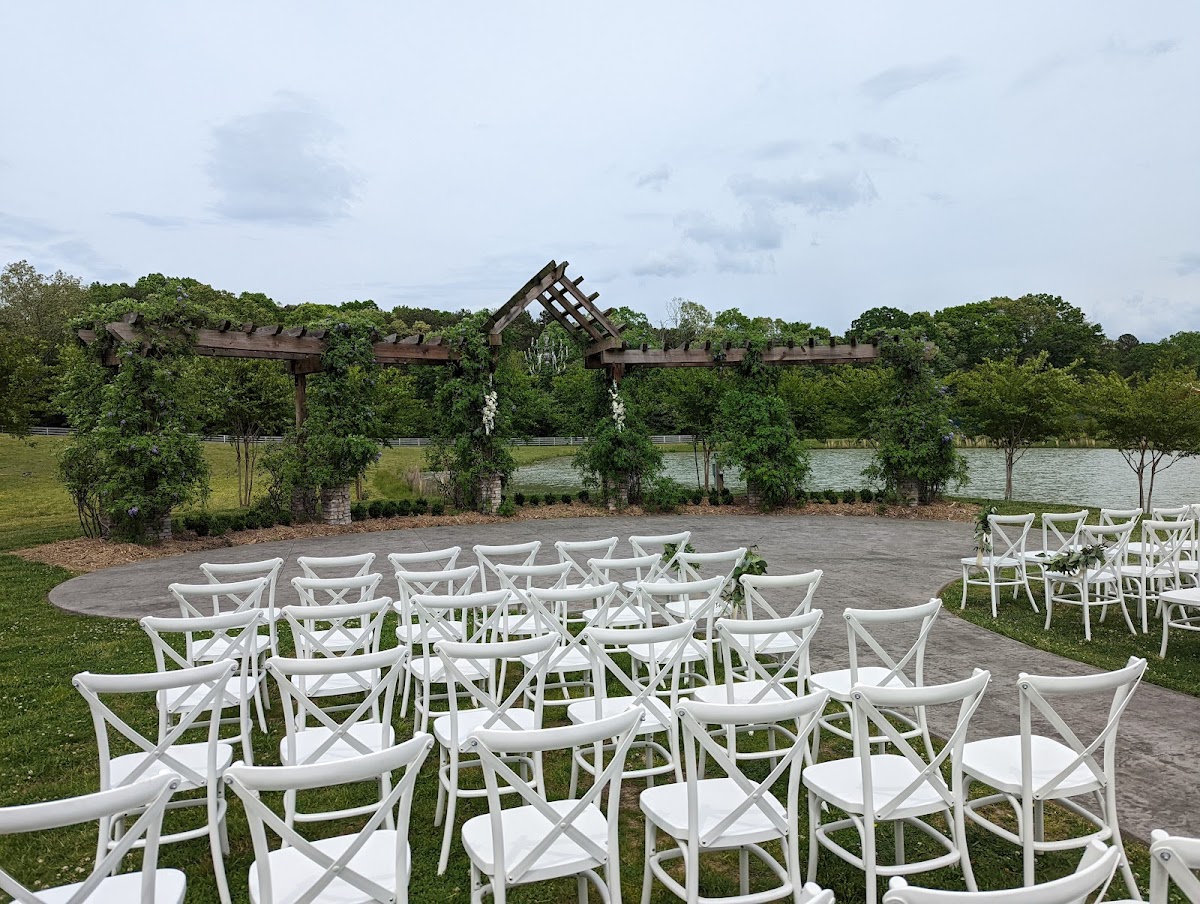
You wind through Georgetown on Runyan Road, past cattle pastures and split-rail fences, past the kind of Tennessee countryside that looks better the farther you get from the interstate. The hills roll in long, gentle swells. Forests close in on both sides. And then, at 7600 Runyan Road, you turn onto Howe Farms — 350 acres that have been hosting weddings long enough to know exactly what they’re doing. The Apple Barn sits toward the back of the property, and the approach tells you everything you need to know. First, the charcoal grey exterior comes into view, sleek and modern against the pastoral backdrop. Then the white-washed barn doors, thrown open to reveal the glow of fifteen crystal chandeliers. And finally, if you walk around back, the ceremony site: wisteria-covered pergolas overlooking a stocked pond, forest rising on three sides, the longest aisle on the entire Howe Farms property stretching out like an invitation. This is not a venue trying to be something it’s not. It is a working farm that happens to have impeccable taste, a barn with 400-year-old bones dressed up in crystal and bistro lights. Poppy has designed The Apple Barn at Howe Farms wedding flowers for 1 celebration here so far, with nearly 100 couples reaching out to inquire, and every time we make the drive from Chattanooga, we’re reminded why this place has such pull.
About The Apple Barn at Howe Farms
The Apple Barn is the boutique option within the Howe Farms portfolio, a venue that balances rustic bones with a level of polish that keeps it from tipping into overly-done farmhouse territory. The barn itself was reconstructed using 400-year-old reclaimed timbers sourced from a barn originally built on General Ulysses S. Grant’s family property in Ohio — a detail that gives the structure both historical weight and a story worth telling. The timbers are dark, weathered, and beautifully imperfect, the kind of wood that looks better with age and provides an anchor for the otherwise bright, airy interior. The walls are white-washed, a choice that floods the space with light and makes the fifteen crystal chandeliers — draped throughout the main hall — sparkle like something out of a European estate sale. The juxtaposition works. You have rusticity underfoot and overhead, glamour at eye level, and the whole effect is Southern elegance without the stuffiness.
The exterior is finished in charcoal grey, a modern touch that photographs exceptionally well and provides dramatic contrast for florals. This is not your grandfather’s red barn. The Apple Barn reads contemporary, sophisticated, and just rustic enough to feel rooted in place rather than imported from a Pinterest board. The property sits on 350 acres of rolling Tennessee countryside about 20 to 30 minutes from downtown Chattanooga, close enough to be convenient for guests staying in the city but far enough to feel like a proper escape. The surrounding landscape is pastoral — forests, fields, ponds, mountain views in the distance — and the venue has been thoughtfully designed to take advantage of every sightline.
Howe Farms operates as a multi-venue property, but The Apple Barn is the gem for couples who want intimacy and polish. The venue accommodates up to 250 guests comfortably, with dedicated spaces for getting ready, cocktail hour, ceremony, and reception all on-site. The events team is professional and organized, which makes vendor coordination straightforward. Setup access begins at 7 AM on the event day, with the option to purchase additional days if more elaborate installations are planned (restrictions may apply). There is ample parking for both guests and vendors in a separate lot, and load-in is easy with direct access to the barn. The venue requires event insurance through their partner Event Helper, a standard ask that protects everyone involved. Alcohol service must be provided by an approved Howe Farms bartender from the preferred vendor list, though you’re welcome to bring your own alcohol with that bartender in place. The catering policy is open — you can hire any caterer you like, not just those on the preferred list — which gives couples flexibility and keeps costs competitive. For florals, there are no restrictions, which is exactly how we like it.
Logistically, the Georgetown location is accessible but rural. Most guests will need personal vehicles or shuttle services, as public transit is virtually nonexistent out here. The drive is scenic, which helps, and the venue’s proximity to Chattanooga makes hotel accommodations easy to arrange. For Poppy’s delivery and setup, the route is straightforward and the venue team is responsive about timing and vendor coordination, which makes our job smoother and ensures the flowers are installed exactly when and where they need to be.
Event Spaces & Floral Opportunities
The Apple Barn Main Reception Hall
Capacity: 250 seated
Setting: The heart of The Apple Barn is this white-washed reception hall, a space that manages to feel both grand and intimate depending on how you fill it. The walls are bright, the ceilings soar, and those fifteen crystal chandeliers are the showstoppers — draped across the space in a way that creates multiple focal points without overwhelming the room. The 400-year-old reclaimed timbers provide the structural drama, dark and textured against the white walls, and the overall palette is neutral enough to work with virtually any color scheme. Large barn doors open directly onto the bistro-lit outdoor patio, creating a seamless indoor-outdoor flow that’s ideal for cocktail hour or late-night dancing under the stars. The flooring is polished but not slick, and the climate control ensures comfort year-round, a non-negotiable in Tennessee where summer heat and winter cold can both be extreme.
Floral approach: This room rewards restraint in some areas and boldness in others. The chandeliers are the obvious anchors, and we have two approaches depending on your aesthetic. For couples who want to lean into the glamour, we can weave greenery garlands — smilax, Italian ruscus, and seeded eucalyptus — through the chandelier chains, adding small clusters of blooms (Quicksand roses, white ranunculus, pale peach lisianthus) at intervals to soften without overwhelming. For a cleaner look, let the chandeliers shine on their own and focus floral impact elsewhere. Guest table centerpieces should either stay low — under twelve inches to preserve sightlines and conversation — or go dramatically tall on risers that lift arrangements well above eye level. Low designs might feature compote bowls filled with garden roses (Keira, Patience, Juliet), scabiosa, astilbe, and trailing jasmine vine in soft blush and cream tones. Tall designs could use clear glass cylinders elevated on gold or acrylic risers, filled with delphinium, foxglove, snapdragons, and eucalyptus to create vertical drama without blocking views. The reclaimed timbers have enough texture and warmth that earth-toned palettes — terracotta, rust, sage, cream — feel particularly at home here. For the entry to the reception hall, consider a large-scale installation flanking the barn doors: two overflowing urns or wooden crates filled with seasonal branches, hydrangea, café au lait dahlias, and cascading greenery to signal the transition from ceremony to celebration. The barn’s neutral backdrop is forgiving, so don’t be afraid of color or volume here.
Outdoor Ceremony Site
Capacity: 250 seated
Setting: This is the longest ceremony aisle at Howe Farms, and it earns that distinction honestly. The wooden pergola structures are covered in wisteria — blooming in late April through May with cascades of purple-blue flowers that smell like grape soda and look like something from a fairy tale — and supported by stacked stone pillars that add weight and permanence to the setting. The aisle stretches between a stocked pond on one side and forest views on the other, creating a natural amphitheater effect where guests feel enclosed by nature but not crowded. The backdrop is pure Tennessee: water, trees, sky, and in spring, that wisteria doing most of the decorative work for you. The site is completely outdoors, so weather is a factor, but the views and the natural beauty make it worth the gamble for couples willing to have a backup plan.
Floral approach: In late spring, when the wisteria is in full bloom, our job is to complement rather than compete. The pergola is already dripping with purple-blue clusters, so additional florals should echo that palette or provide contrast without clashing. Consider soft whites, creams, and blush tones — white peonies, Polo roses, white lisianthus, and jasmine vine — woven into garlands that wrap the stone pillars at the base of the pergolas. The pillars themselves are beautiful and sturdy enough to support larger installations: imagine urn arrangements at the base of each pillar filled with delphinium, white hydrangea, eucalyptus, and trailing ivy. For the aisle, the length calls for restraint. Rather than lining every row, mark every third or fourth row with a cluster of blooms — a tied bundle of lavender, white roses, and eucalyptus attached to shepherd’s hooks or lantern stakes — to guide the eye without cluttering the sightline. At the altar end, a freestanding wooden arbor or metal arch can be dressed with greenery and blooms, though honestly, in peak wisteria season, the pergola does that work for you. Outside of wisteria season, the ceremony site still has the pond, the forest, and the stone pillars, which means the bones are strong year-round. In summer and fall, we’d recommend a more robust ceremony arch — perhaps a triangular wooden structure covered in smilax, quicksand roses, burgundy dahlias, and amaranthus — to create a focal point that anchors the space. The long aisle also allows for a dramatic entrance moment: consider a flower girl scattering petals the entire length, or a ribbon-draped aisle runner with floral accents at intervals.
Outdoor Patio
Setting: Directly accessible from the barn’s interior, this patio is strung with bistro lights that create a canopy of warm, golden glow once the sun goes down. Exterior uplighting highlights the barn’s charcoal grey exterior and washes the space in soft, ambient light. The patio is large enough to accommodate cocktail tables, a bar setup, and a dance floor if you want to move the party outside for the later hours. The transition from indoor reception to outdoor patio is seamless — no stairs, no bottlenecks, just open barn doors and an invitation to step outside.
Floral approach: The bistro lights are doing most of the atmospheric heavy lifting here, so florals should enhance rather than distract. Cocktail tables benefit from small, tight arrangements — bud vases with a few stems of café au lait dahlias and eucalyptus, or small compote bowls with garden roses and scabiosa — that add color and texture without taking up valuable drink real estate. The bar is a prime opportunity for a statement piece: a long, low arrangement running the length of the bar top (or a pair of larger arrangements at each end) featuring seasonal blooms, plenty of greenery, and perhaps some trailing elements like jasmine vine or amaranthus that soften the edges. If you’re using the patio for dancing, consider potted plants or lanterns with floral accents at the perimeter to define the space without creating barriers. The uplighting on the barn exterior creates a beautiful backdrop for photos, and florals placed near the barn doors — think oversized urns or wooden boxes filled with blooms — will be highlighted by that light and look stunning in evening portraits.
Bridal Suite
Capacity: 8 people
Setting: This is a proper getting-ready space, not an afterthought. White-washed walls keep the room bright and camera-friendly, and the dress display nook is purpose-built for those hanging-gown shots that every bride wants. Salon chairs, vanity lighting, and mirrors accommodate the bridal party comfortably, and the overall vibe is elegant without being overly fussy. There’s enough room to move, enough light to do makeup, and enough style to make the morning-of photos look intentional.
Floral approach: The dress display nook is the star here. A small floral accent — three to five stems of the bride’s bouquet flowers in a bud vase or a small trailing piece hung on the same hook as the dress — adds cohesion to the detail shots and connects the getting-ready photos to the rest of the day’s floral story. On the vanity, a low, lush arrangement in soft tones (blush, cream, white) provides a beautiful backdrop for bouquet and detail photos without taking up too much space. Think garden roses, ranunculus, and hellebores in a shallow bowl or vintage silver tray. If you want to go a step further, individual bud vases at each vanity station with a single bloom for each bridesmaid is a thoughtful touch that photographs beautifully.
Groom’s Quarters (Bow Tie Club)
Setting: The Bow Tie Club is exactly what it sounds like: a masculine retreat for the groom and his crew. The bar, made from the original barn beams, is the centerpiece — rustic, substantial, and functional. There’s a massage chair for pre-ceremony relaxation, and the overall aesthetic leans into dark wood, leather, and a kind of gentlemen’s club vibe that balances the bridal suite’s elegance with something a bit more laid-back.
Floral approach: Florals here should be understated and masculine. The bar is the natural spot for an arrangement: think greenery-heavy with minimal blooms, perhaps white roses, eucalyptus, and succulents in a dark ceramic or concrete vessel. The goal is texture and sophistication without veering into floral overload. A single statement piece on the bar top is enough. If you want to add a bit more, consider small potted succulents or air plants on side tables — elements that feel organic and modern rather than traditionally floral. This is also a great space to incorporate non-floral greenery like olive branches, magnolia leaves, or even herbs (rosemary, sage) that add scent and visual interest without reading as overtly feminine.
Wedding Flower Ideas for The Apple Barn at Howe Farms
Tennessee Sunset
This palette draws from the warm, golden light that filters through the Tennessee hills at dusk — the exact light you’ll have during cocktail hour if you time it right. Start with a base of rich terracotta and burnt orange: dahlias in varieties like Labyrinth and Totally Tangerine, paired with peach-toned roses (Juliet, Free Spirit, and Romantic Antike). Add depth with burgundy touches — Black Bacarra roses, burgundy scabiosa, and chocolate cosmos — and lighten the whole thing with cream and blush accents from Quicksand roses, champagne lisianthus, and pale peach ranunculus. Textural elements include dried grasses, bunny tail, and rust-colored amaranthus. Vessels should be earthy: terracotta pots, wooden boxes, aged brass compotes. This palette is stunning in the main reception hall against the white-washed walls and reclaimed timbers, and it works beautifully on the outdoor patio as the sun sets. For the ceremony, terracotta and peach florals on the stone pillars will glow in natural light.
Southern Garden Romance
A softer, more traditional approach that leans into lush, garden-style florals in a palette of blush, cream, ivory, and soft lavender. Garden roses are the stars here: Patience, Keira, Constance, and White O’Hara, massed together with peonies (in season), ranunculus, sweet peas, and hellebores. Add texture with jasmine vine, smilax, and seeded eucalyptus, and finish with touches of lavender or tweedia for that soft purple accent. Vessels should feel vintage and romantic: mercury glass compotes, silver julep cups, ceramic urns in soft grey or cream. This palette works year-round and is particularly lovely in the bridal suite, on ceremony aisle markers, and as low centerpieces in the reception hall where the soft tones won’t compete with the chandeliers. The abundance of blooms and the organic, just-picked-from-the-garden aesthetic pairs beautifully with the barn’s rustic elegance.
Modern Farmhouse
For couples who want a cleaner, more contemporary look, this concept combines organic shapes with a restrained color palette and unexpected elements. Start with a base of white and green: white roses (Patience, Polo, Playa Blanca), white ranunculus, white anemones, and loads of textural greenery (eucalyptus, Italian ruscus, olive branches). Add visual interest with geometric vessels — concrete cubes, black ceramic cylinders, brass hexagonal holders — and unexpected elements like succulents, air plants, or even kale and ornamental cabbage for texture. The look is fresh, unfussy, and modern without being cold. This palette shines in the Groom’s Quarters where the masculine aesthetic calls for something a bit more architectural, and it works beautifully in the main hall if you want the crystal chandeliers to remain the star while the florals provide clean, modern accents. For the ceremony, a geometric metal arch covered in greenery and white blooms creates a striking focal point.
Seasonal Considerations
The Apple Barn sits in the Tennessee countryside, which means four distinct seasons and floral availability that shifts accordingly. Understanding what thrives when — and what the weather will do to your plans — is essential.
Spring (March-May): Spring in Georgetown is unpredictable. March can still dip into the 40s at night, while May might hit 80 during the day. The landscape comes alive with dogwoods, redbuds, and that famous wisteria on the ceremony pergolas, which typically blooms late April into early May. This is peak wisteria season, and if you can time your wedding to catch it, the ceremony site is unmatched. Spring brings tulips, daffodils, hyacinths, ranunculus, anemones, and the first peonies toward the end of May. The weather is ideal for outdoor ceremonies — mild, breezy, and beautiful — but have a rain plan, because spring storms roll through without much warning. Florals are abundant and reasonably priced in spring, and the natural landscape is so lush that you can scale back on ceremony florals and let the wisteria and surrounding greenery do the work.
Summer (June-August): Tennessee summers are hot, humid, and not for the faint of heart. Daytime temperatures regularly push into the 90s, and the humidity makes everything feel ten degrees warmer. The Apple Barn’s climate-controlled interior is a blessing, but outdoor ceremonies require serious consideration. If you’re set on an outdoor ceremony, schedule it for late afternoon or early evening when temperatures drop slightly, and make sure your florist (hello, that’s us) uses heat-tolerant blooms and proper hydration techniques. Summer flowers include zinnias, sunflowers, dahlias, lisianthus, and hydrangeas, all of which can withstand heat better than delicate garden roses or peonies. The long summer days mean golden hour light stretches well into evening, which is perfect for that bistro-lit patio. Just keep guests hydrated, provide fans or parasols, and embrace the season rather than fighting it.
Fall (September-November): Fall is the sweet spot. Temperatures cool into the 60s and 70s, humidity drops, and the surrounding forests put on a show of red, orange, and gold foliage that rivals any floral installation. This is peak wedding season in Tennessee, and for good reason. Fall brings dahlias in their full glory — dinner-plate varieties, cactus dahlias, pompom dahlias — along with chrysanthemums, marigolds, celosia, and the last of the garden roses. The natural landscape is so vibrant that ceremony florals can be minimal, with aisle markers and a simple arch allowing the forest backdrop to shine. For reception florals, lean into the seasonal palette: rust, burgundy, gold, and cream. The outdoor patio is perfect for fall evenings, and the bistro lights against the autumn sky create a magic that’s hard to replicate any other time of year.
Winter (December-February): Winter at The Apple Barn is quiet, intimate, and surprisingly lovely. Temperatures range from the 30s to 50s, and while snow is possible, it’s not guaranteed. The bare trees and dormant landscape create a stark, minimalist beauty that works well for couples who want a cozy, romantic vibe. Winter florals include amaryllis, hellebores, ranunculus, anemones, and evergreen branches (pine, cedar, magnolia). Incorporating seasonal elements like pinecones, berries, and twigs adds texture and ties the florals to the season without feeling overly Christmas-y unless that’s your goal. The climate-controlled barn is warm and inviting, and winter weddings benefit from lower venue demand and often better vendor availability. For florals, winter is when we get creative with dried elements, branching, and rich, moody palettes that feel appropriate for the season.
Poppy’s Expert Take
The wisteria waits for no one. If you want your ceremony under those purple-blue cascades, you need to book a late April or early May date and understand that nature sets the schedule, not you. Wisteria bloom time can shift by a week or two depending on the spring weather, and there’s no guarantee it’ll be peak on your exact date. We’ve seen it bloom early, bloom late, and occasionally get knocked back by a late frost. If wisteria is non-negotiable, consider having a beautiful ceremony arch design as a backup so your ceremony site still looks intentional even if the blooms aren’t cooperating. And if the wisteria does bloom for you? Scale back on additional ceremony florals and let it be the star.
Chandelier installations require advance planning and the right rigging. Those fifteen crystal chandeliers are gorgeous, but they’re also high, varied in height, and not all equally accessible for installations. If you want greenery garlands or floral elements woven through them, we need detailed photos of each chandelier’s height and attachment points, and we need setup time — this is not a day-of decision. The venue’s magnetic beams allow for some suspended elements without drilling, but anything attached to the chandeliers themselves requires careful planning and often a ladder or lift. Start this conversation with your florist at least two months out, and budget accordingly, because labor for overhead installations is priced separately.
The outdoor patio is your late-night secret weapon. So many couples focus all their energy on the ceremony and reception hall and treat the patio as an afterthought, but this space becomes the heart of the party once the sun goes down. Those bistro lights create an ambiance that’s impossible to replicate indoors, and guests will naturally drift outside to cool off, chat, and dance under the stars. Invest in a few statement florals here — the bar, the entrance from the barn, maybe a lounge area if you’re setting one up — because this is where your photographer will shoot the last dance, the sparkler exit, and the late-night portraits that feel the most romantic.
The charcoal grey exterior is a gift for bold color palettes. If you’ve been told that bright florals won’t photograph well or that you should stick to soft, neutral tones, ignore that advice here. The Apple Barn’s dark exterior provides the kind of contrast that makes jewel tones, bright corals, deep burgundies, and even bold oranges look absolutely stunning in photos. Poppy loves working with couples who embrace color at this venue because the results are so visually striking. Don’t be afraid to go bold, especially for ceremony florals on the stone pillars or large arrangements flanking the barn entrance.
The pond ceremony site is stunning but requires floral restraint. The water, the forest, the natural amphitheater effect — it’s all there. Overloading this space with florals actually detracts from its beauty. We’ve seen couples try to line every single aisle chair, add massive altar arrangements, and install elaborate arches, and the result is visual clutter that pulls focus from the landscape. A better approach: minimal aisle markers (every third or fourth row), a simple garland on the stone pillars, and perhaps a low, organic installation at the altar that doesn’t block the pond view. Let the setting do the work.
Budget for the long aisle. The outdoor ceremony site has the longest aisle at Howe Farms, which is wonderful for the drama of the processional but means that aisle florals add up quickly if you’re not strategic. Instead of lining every row, consider clusters at the start and end of the aisle, with every third or fourth row marked in between. Alternatively, use non-floral elements like lanterns, candles in hurricane vases, or potted plants that can be repurposed for the reception. This keeps the aisle looking intentional without blowing your budget on blooms that will only be seen for twenty minutes.
What Poppy Couples Spend on Flowers Here
Based on our experience at The Apple Barn and the one wedding we’ve designed here so far, couples are investing around $4,030 on average for their wedding flowers. That figure reflects a full-service floral design for a venue of this size and caliber, and it’s a helpful benchmark as you start planning. Here’s how that investment typically breaks down across three tiers.
$2,500 - $3,500 | The Essentials
This tier covers the non-negotiables: a bridal bouquet, boutonnieres for the groom and groomsmen, and bridesmaid bouquets in a complementary style. For the ceremony, you’d have simple arrangements on the stone pillars at the outdoor ceremony site — perhaps low urns filled with seasonal greenery and a few focal blooms — and minimal aisle markers, maybe every fourth row, using tied bundles of flowers or single stems in small vases. Inside the reception hall, this budget supports low centerpieces on guest tables (one per table in a tight, garden-style design using seasonal blooms), a bar arrangement, and a small piece for the welcome table or guestbook area. The bridal suite gets a small accent arrangement for detail photos, and that’s the program. This tier works beautifully if the natural beauty of the venue and the wisteria (in season) are doing most of the decorative work and you want florals to accent rather than dominate. It’s a clean, unfussy approach that ensures the essential moments are covered without stretching the budget.
$3,500 - $5,500 | The Full Picture
This is where most Poppy couples land at The Apple Barn, and it’s the tier that allows for a cohesive floral story across the entire day. In addition to everything in the Essentials tier, you’re adding ceremony impact: larger arrangements at the base of the stone pillars, more frequent aisle markers (every second or third row), and potentially a garland or floral installation on the pergola structure if you’re outside of wisteria season. Inside the reception hall, you have the option to upgrade some centerpieces to taller, more dramatic designs on risers, or to add greenery garlands to a few of the crystal chandeliers to create overhead interest. The outdoor patio gets a longer, more substantial bar arrangement — perhaps a lush runner with trailing elements — and cocktail tables each get a small bud vase or compote arrangement. You’re also adding statement pieces at key transitions: large urns or wooden boxes flanking the barn entrance, an arrangement on the bar in the Bow Tie Club, and a more substantial piece in the bridal suite. This tier gives you flexibility to emphasize the spaces that matter most to you while maintaining a consistent aesthetic throughout.
$5,500+ | The Full Experience
This is the tier for couples who want florals to be a defining element of their wedding day. Everything