
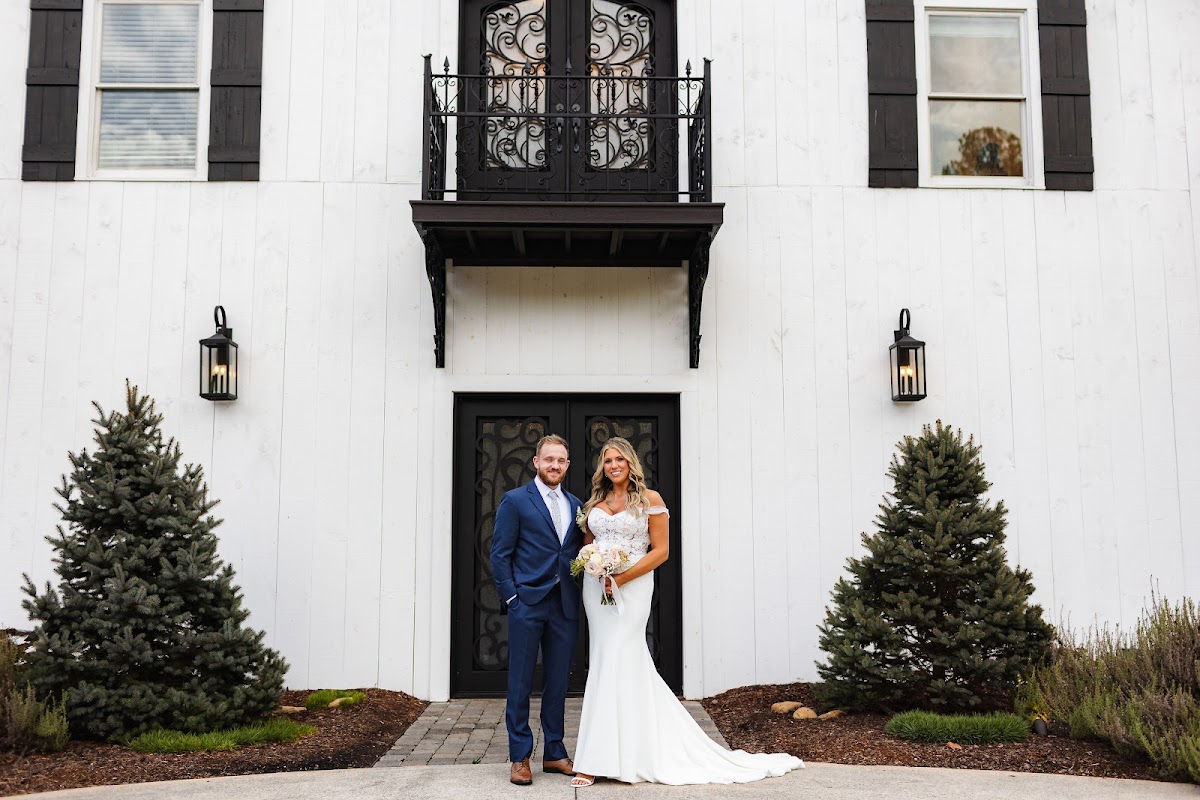
You turn off I-75 onto Crow Valley Road and the shift is immediate. The commercial strip fades behind you, replaced by the kind of rural North Georgia landscape that doesn’t announce itself — it simply exists, patient and unhurried. Pastureland stretches on both sides, punctuated by stands of longleaf pine. The road narrows. And then, tucked into 65 acres of pine forest, Clisby Pines reveals itself. The name change from Circle B happened quietly, but the property’s identity remains unchanged: a white-washed Grand Hall rising from the tree line like a modern interpretation of a Southern estate, all clean lines and soaring glass, surrounded by the soft rustle of pine needles underfoot and the occasional call of wood thrushes. Drive another hundred yards and you’ll see the lake with its fountain, then the stone fireplace standing sentinel in the ceremony clearing, framed by the forest canopy. It is the kind of place that makes you slow down involuntarily, that pulls the tension from your shoulders before you’ve even stepped out of the car. Poppy has designed Clisby Pines wedding flowers for 1 celebration here so far, but with 8 leads in the pipeline and couples increasingly seeking out this blend of natural beauty and modern elegance, we’re learning this property’s rhythms — and we’re ready to share what makes flowers sing here.
About Clisby Pines
Clisby Pines sits just northwest of Tunnel Hill, Georgia, roughly 20 miles south of Chattanooga, Tennessee, and easily accessible from the I-75 corridor that connects Atlanta and Knoxville. The property’s 65 acres are mostly forested — a thick canopy of loblolly and white pines that have been here longer than the venue itself, with walking paths winding through the understory and a spring-fed lake near the entrance. This is working North Georgia countryside, the kind of place where you can still see the Appalachian foothills rising to the east and where the air smells like red clay after a rain. The venue was purpose-built for events, which means everything — from the commercial kitchen to the ample parking — was designed with weddings in mind rather than retrofitted from a historic barn or family estate.
The Grand Hall is the architectural centerpiece, and it’s striking in its simplicity. Two stories of white-washed tongue-and-groove siding, cathedral ceilings supported by exposed hardwood beams, and walls of windows that flood the space with natural light. The twin curved staircases are the showstopper — they frame the room like parentheses, elegant and symmetrical, rising to a second-story balcony that overlooks the main floor. Crystal chandeliers hang at intervals, adding sparkle without overwhelming the space. The aesthetic is Southern farmhouse refined: clean, bright, and intentionally neutral so that any design direction — from moody jewel tones to airy pastels — can take root.
Outside, the ceremony site is anchored by a stacked-stone fireplace that serves as a natural altar, with the pine forest creating a verdant backdrop. There’s a covered patio strung with bistro lights for cocktail hours, separate bridal and groom’s quarters (the bridal suite opens onto that second-story balcony with French doors), and the lake, which reflects the sky and makes for lovely golden-hour portraits. Clisby Pines operates as an all-inclusive venue in many respects — tables, chairs, basic decor, and setup/teardown are included in the rental — but couples have the freedom to bring in their own florist, caterer, and other vendors. For Poppy’s delivery team, the drive from our Chattanooga-area operations is straightforward, load-in access is generous with a private entrance to the kitchen, and the venue staff has been organized and communicative in our experience. The 16-hour rental window (7 a.m. to 11 p.m.) provides ample time for installation, ceremony, reception, and breakdown without the rushed feeling that plagues some venues.
Logistically, this is a venue that works. Parking is plentiful. There are golf carts available for navigating the property. The bridal suite includes a mini fridge, salon chairs, and good natural light — all the things that make a getting-ready space functional. The white walls and neutral palette mean florals don’t have to fight with existing decor, and the combination of dramatic architectural features (those staircases, that fireplace) and natural beauty (the forest, the lake) gives us multiple focal points to enhance rather than create from scratch.
Event Spaces & Floral Opportunities
Grand Hall / Main Reception Hall
Capacity: 250 seated
Setting: The Grand Hall at Clisby Pines is, in a word, luminous. Cathedral ceilings soar overhead, supported by honey-toned hardwood beams that draw the eye upward. The white-washed walls act as a giant reflector, bouncing natural light from the large windows throughout the two-story space. Crystal chandeliers hang at calculated intervals, glittering without competing for attention. And then there are the staircases — twin curves of hardwood with wrought-iron railings that sweep up both sides of the room to the second-floor balcony. It’s a room that photographs beautifully from every angle, with sightlines that encourage movement and discovery. The venue can accommodate both ceremony and reception here, with guests entering through one set of doors for the ceremony and the space later transforming for dinner and dancing.
Floral approach: The twin staircases are your primary floral opportunity and they demand a considered approach. Cascading garlands work beautifully — think smilax, Italian ruscus, and seeded eucalyptus as the base, punctuated every 18 inches with clusters of blooms. For a spring wedding, that might mean Patience garden roses in soft blush, white ranunculus, and trailing jasmine vine. For fall, consider Café au Lait dahlias, toffee-toned Quicksand roses, and burgundy hypericum berries woven through. The garlands should start fuller at the base and taper as they ascend, following the natural line of the staircase rather than fighting it. Alternatively, simple greenery garlands dressed with ribbon and a few statement blooms at the newel posts create elegance without the labor-intensive full treatment. For centerpieces, the high ceilings allow for tall arrangements — 30-inch gold stands topped with exploding garden-style designs in compote bowls work beautifully here, lifting the flowers above guest sightlines while filling the vertical space. Or go low and lush with arrangements in aged stone vessels that echo the outdoor fireplace, mounded with garden roses, lisianthus, and scabiosa. The white walls mean color pops dramatically — a palette of coral charm peonies, peach stock, and apricot spray roses will read beautifully against the bright backdrop. If you’re doing both ceremony and reception in this space, consider a substantial altar arrangement that can later be repositioned as a focal point near the head table or cake display. The crystal chandeliers are lovely on their own; resist the urge to over-dress them. A simple greenery garland woven loosely through one or two of them is sufficient.
Outdoor Ceremony Site
Capacity: 250 seated
Setting: The ceremony site sits in a clearing within the pine forest, with the stacked-stone fireplace as the natural focal point. The fireplace is substantial — easily eight feet tall, built from varying shades of gray and tan fieldstone — and functions as both altar and architectural statement. Behind it, the pine forest rises in soft focus, all vertical trunks and dappled light. A stone walkway leads from the patio to the ceremony space, wide enough for a processional and flanked by manicured grass where chairs are arranged. The site can be tented if weather demands, and the surrounding trees provide natural shade during the heat of the day.
Floral approach: The stone fireplace is the star, and your florals should enhance rather than obscure it. A classic approach is a lush mantel arrangement — think 6 to 8 feet long, draping slightly over the edge, built on a foam base or in a series of connected vessels. For a romantic garden look, use Patience and Juliet garden roses in blush and ivory, white lisianthus, blush astilbe, and trailing jasmine vine or passion vine to create movement. Incorporate dusty miller and eucalyptus for silvery contrast against the stone. For couples wanting more structure, flank the fireplace with two tall arrangements in aged bronze urns — symmetrical but not identical, with height differential to avoid a too-formal look. These can be built on stakes to reach 6 feet or more, using branches (curly willow in spring, oak leaf branches in fall) as the structure, then filled in with blooms and foliage. An alternative approach is an asymmetrical floral arch positioned slightly to one side of the fireplace, creating a layered effect that plays with depth. Use a wooden or metal arch base and dress it heavily on one side, allowing it to cascade and tumble naturally. This works especially well with looser, organic blooms like hellebores, ranunculus, and sweet peas. For the aisle, consider simple arrangements in low stone urns every third row — these mark the processional path without obstructing views. If you’re repurposing ceremony flowers for the reception, ensure the fireplace arrangement is built in a way that can be disassembled into smaller pieces (multiple vessels rather than one long foam base) or that the urn arrangements are on wheeled stands for easy transport back to the Grand Hall. The pine forest backdrop provides all the greenery you need; resist the urge to add excessive foliage to your designs and instead let the blooms be the focus.
Bridal Suite
Capacity: Preparation space
Setting: The bridal suite occupies part of the second floor, accessible via one of those twin curved staircases. French doors open onto the balcony that overlooks the Grand Hall, providing not only a bird’s-eye view of the reception setup but also a dramatic entrance opportunity — imagine the bride appearing at the balcony railing for a first look with her father or for a grand reveal to the groom below. Inside, the suite features salon chairs, a mini fridge, catering area, and an en-suite restroom. Crystal chandeliers match those in the main hall, and the same white-washed walls and hardwood accents create continuity. Large windows provide good natural light for getting-ready photos.
Floral approach: The bridal suite benefits from a few carefully chosen floral touches rather than full-scale installations. A small arrangement on the vanity or dressing table — perhaps a low bowl of Juliet roses, white ranunculus, and eucalyptus — adds romance to detail shots without taking up precious counter space. If you’re doing bouquets displayed in the suite for photos, consider hanging them on the French doors or balcony railing with silk ribbon in a complementary color. A floral hoop or wreath hung on the wall near the salon chairs creates a lovely backdrop for candid getting-ready shots. Keep it simple: a 24-inch hoop wrapped in smilax and dotted with blooms that pull from the bridal bouquet palette. If budget allows, a single statement stem in a bud vase for each bridesmaid at her chair is a thoughtful touch that photographs beautifully without breaking the bank — one café au lait dahlia, one peony, one garden rose each.
Groom’s Quarters
Capacity: Preparation space
Setting: The groom’s quarters are a separate space with lounge furniture, a flat-screen TV, mini fridge, and a more masculine, laid-back vibe. This is the room where the guys will be hanging out, having a drink, and getting dressed without the fuss of the bridal suite.
Floral approach: Florals here should be understated and masculine. A single arrangement on the bar cart or console table — built in a wooden or concrete vessel with greenery-forward styling — is sufficient. Think scabiosa pods, eucalyptus, olive branches, and perhaps a few burgundy dahlias or dark purple hellebores for depth. Boutonnieres can be pinned to a linen-wrapped board and displayed on a side table or hung on the wall for photos. The focus here is on complementing the space without overwhelming it; this is about grounding the overall floral story with a nod to the masculine side of the celebration.
Patio Area
Capacity: Cocktail hour or reception overflow
Setting: The covered patio area connects the indoor and outdoor spaces, strung with bistro lights that create a warm glow as evening falls. It’s a transition zone — often used for cocktail hour after the ceremony while the Grand Hall is being flipped for the reception, or as an overflow space for guests who want to step outside during dancing.
Floral approach: Keep it light and mobile here. Cocktail tables benefit from small arrangements in bud vases or short cylinder vases — groups of three vases in varying heights with a single bloom type in each (one dahlia, one rose, one spray of eucalyptus) create visual interest without requiring elaborate design. These are easy to move if the space needs to shift, and they’re budget-friendly. If the patio railings are visible and accessible, consider a greenery garland — smilax or seeded eucalyptus loosely draped and zip-tied at intervals, with clusters of blooms at the corners. This creates cohesion with the indoor staircase garlands and helps bridge the indoor/outdoor aesthetic. If the bistro lights are on a structure that can support additional weight, you could incorporate hanging elements — small floral clusters suspended at varying heights with fishing line — but confirm with the venue first about weight limits and attachment points.
Lake with Fountain
Capacity: Photo location and natural feature
Setting: The spring-fed lake sits near the entrance to the property, with a fountain in the center creating gentle movement and sound. The lake is surrounded by natural grasses and pines, and the water reflects the sky beautifully during golden hour.
Wedding Flower Ideas for Clisby Pines
Southern Pine
This concept leans into the venue’s natural setting with a palette inspired by the forest canopy and the dappled light filtering through. Begin with a base of mixed evergreens — white pine boughs, cedar, and noble fir — accented with blooms in cream, soft yellow, and moss green. Café au Lait dahlias, Patience garden roses, and white lisianthus provide the floral weight, while green hellebores, chartreuse button mums, and Queen Anne’s lace add texture and movement. Incorporate natural elements like pine cones (wired into arrangements or scattered on tables), acorns, and bits of lichen-covered branches. Vessels should be organic: aged wooden boxes, moss-covered compotes, birch bark-wrapped cylinders. For the ceremony fireplace, build a generous mantel arrangement that looks as though it grew from the stone itself, with evergreen boughs trailing down and blooms clustered asymmetrically. This palette works beautifully year-round but is especially striking in winter when the natural greenery outdoors has faded, making the evergreen installations inside feel like an extension of the forest’s evergreen backbone.
Blush & Honey
A softer, more romantic take that plays with the warmth of the Grand Hall’s hardwood and honey-toned beams. The palette centers on blush, peach, ivory, and touches of deep mauve, with metallic gold accents in vessels and candleholders. Blooms include Juliet and Keira garden roses in peach and apricot, blush ranunculus, quicksand roses in that perfect taupe-pink, white lisianthus, and soft peach stock for vertical interest. Foliage is kept light — seeded eucalyptus, dusty miller, and delicate jasmine vine that trails from arrangements. Vessels are aged brass compotes, gold-rimmed milk glass, and mercury glass votives clustered on tables. For the staircases, garlands are built on a smilax base with clusters of blush blooms and trailing peach ribbon in silk or velvet. The ceremony fireplace gets a lush, overflowing arrangement in these tones, with tapered candles in gold holders flanking it for added romance. This is a palette that photographs beautifully in the bright white space, with enough depth to avoid looking washed out but enough softness to feel romantic rather than dramatic.
Deep Forest
For couples drawn to moodier, more dramatic aesthetics, this concept embraces deep jewel tones and textural foliage that reference the shadows and undergrowth of the pine forest. The palette includes burgundy, plum, deep teal, and charcoal, with blooms like Black Baccara roses, deep purple anemones, burgundy dahlias (Chat Noir, Black Satin), dark purple hellebores, and chocolate cosmos. Foliage includes dusty plum smoke bush, dark privet berries, blackberry branches with fruit, and deep green magnolia leaves. Vessels are matte black ceramic, aged bronze urns, and dark wood boxes. The effect is rich, sophisticated, and unexpected against the white walls — the contrast makes the deep colors pop dramatically. For the staircases, consider garlands built on a base of magnolia leaves with clusters of dark blooms and burgundy velvet ribbon. The ceremony fireplace gets a dramatic, asymmetrical arrangement that spills off one side of the mantel, built with dark branches (manzanita or curly willow stained dark) as structure. This palette is stunning for fall and winter weddings but also works beautifully for summer evening receptions when you want to create a moodier, candlelit atmosphere.
Seasonal Considerations
Tunnel Hill sits in the northwest corner of Georgia, in the foothills of the Appalachian Mountains, where the climate is humid subtropical with four distinct seasons. Understanding the region’s weather patterns and what’s in bloom locally helps us design with the landscape rather than against it.
Spring (March through May) brings variable weather — warm, breezy days interrupted by afternoon thunderstorms, and temperatures ranging from the 60s to the 80s. This is dogwood and azalea season in North Georgia, with redbuds and Bradford pears (love them or hate them) blooming along roadsides. Locally available blooms include tulips, daffodils, hyacinths (early season), peonies (late season, and they’re glorious), ranunculus, anemones, and sweet peas. Garden roses are available but not yet at peak abundance. The pine forest will be brightening with new growth, and the lake reflects a clear blue sky. Spring weddings at Clisby Pines benefit from the natural blooming landscape — the surroundings are already lush and colorful, so you can be more selective with your floral budget. Practical considerations: have a rain plan for outdoor ceremonies, and be mindful that afternoon temperatures can climb quickly; delicate blooms like sweet peas may wilt in direct sun, so keep ceremony arrangements shaded or use heartier blooms for outdoor installations.
Summer (June through August) is hot and humid, with temperatures regularly in the 90s and afternoon thunderstorms a near-daily occurrence. The forest canopy is thick and green, providing good shade around the ceremony site. Locally available blooms include zinnias, sunflowers, lisianthus, celosia, dahlias (starting mid-summer), and hydrangeas. Garden roses are at peak availability, though they’ll need to be kept well-hydrated. Summer is also when you can source interesting foliage like local ferns, hosta leaves, and blackberry vines with fruit. The heat requires careful planning: avoid delicate blooms that wilt quickly (tulips, anemones), opt for sturdy varieties (roses, dahlias, lisianthus), and ensure all arrangements are deeply hydrated the day before and set up as close to the event as possible. Outdoor arrangements should be placed in shade and given fresh water cuts. The Grand Hall’s air conditioning is a blessing; move ceremony florals inside as soon as the ceremony concludes. Embrace the lushness of summer by going garden-style in your designs — loose, organic, and abundant rather than structured and precious.
Fall (September through November) is the sweet spot at Clisby Pines. Temperatures drop into the 60s and 70s, the humidity breaks, and the forest starts its slow transition to autumn color — the pine needles turn bronze before dropping, and any deciduous trees on the property shift to gold and red. This is prime wedding season in North Georgia, and it’s easy to see why. Locally available blooms include dahlias (at their absolute peak), garden roses, chrysanthemums, marigolds, celosia, and late-season zinnias. You can also source beautiful foliage: oak leaves in rust and red, bittersweet vines with orange berries, and ornamental grasses that have gone to seed. The color palette can lean into warm, earthy tones that echo the landscape, or you can provide contrast with deep jewel tones or soft pastels. Fall light is golden and warm, especially in late afternoon — perfect for photography and for showing off the natural beauty of the pine forest. Practical considerations: this is peak season, so book your floral designer early, and expect pricing to reflect increased demand.
Winter (December through February) in North Georgia is mild compared to points north, but cold snaps do happen, and occasional snow or ice is possible. Temperatures range from the 30s to the 50s. The pine forest remains green — a significant advantage over deciduous woodland venues, which can look stark in winter. Locally available blooms include amaryllis, paperwhites, ranunculus, anemones, hellebores, and winter jasmine. Evergreen foliage is abundant: pine, cedar, fir, magnolia, holly with berries, and eucalyptus. Winter weddings at Clisby Pines benefit from the venue’s strong indoor space — the Grand Hall is cozy and bright, and the crystal chandeliers feel especially magical when it’s cold and dark outside. Lean into a winter aesthetic with evergreens, berries, and rich, saturated colors (burgundy, emerald, deep plum) or go crisp and clean with whites, silvers, and winter greens. Practical considerations: if you’re planning an outdoor ceremony, have a solid backup plan and communicate it to guests in advance. Ceremony florals can easily move indoors to the Grand Hall if needed. Heating tents are an option for the patio if you want to use it for cocktails, and candles (real or LED) become an essential part of the ambiance in the shorter daylight hours.
Poppy’s Expert Take
The staircases are non-negotiable focal points. If your budget only allows for florals in a few key spots, those twin curved staircases in the Grand Hall should be at the top of the list. They’re the first thing guests notice when they walk in, they photograph beautifully, and they frame the entire space. Even a simple greenery garland makes a significant impact. If you want to elevate it, add blooms in clusters rather than continuously — this gives you the visual punch of a fully dressed staircase without the cost of flowers every six inches. We typically recommend garlands that are fuller at the base (where guests are close and can appreciate the detail) and taper as they ascend. Use zip ties and floral wire to secure them to the railings; the venue is amenable to careful installation that doesn’t damage the hardwood or ironwork.
Design for repurposing between ceremony and reception. Many couples choose to hold both ceremony and reception in the Grand Hall, which means there’s a flip period while guests are at cocktail hour on the patio. Any ceremony florals — altar arrangements, aisle markers, etc. — should be designed with mobility in mind. Use wheeled stands for large arrangements, build altar pieces in vessels that can be easily carried, and communicate with your venue coordinator about the flip timeline. We typically reposition the ceremony altar arrangement to the head table or near the cake display for the reception, and aisle arrangements move to the bar or gift table. This maximizes your investment and ensures the space feels fully designed for both parts of the celebration.
Don’t fight the white walls — use them. The all-white interior of the Grand Hall can feel like a blessing or a curse depending on your design approach. It’s a blessing because any color palette will work beautifully and your florals will stand out dramatically against the neutral backdrop. It’s a curse if you try to make the space feel cozy or intimate with florals alone — you’ll need massive installations to warm up that much white, which blows budgets quickly. Instead, embrace the bright, airy aesthetic and use florals as punctuation marks: bold color on the tables, lush garlands on the stairs, statement arrangements at key spots. Work with your rental company to add warmth through linens, chargers, and candles in warm metallics (gold, brass, copper). The combination of thoughtfully placed florals and warm table settings will create the intimacy you’re looking for without requiring you to florally upholster the entire room.
The outdoor ceremony site needs less than you think. The stone fireplace and pine forest backdrop are incredibly photogenic on their own. Couples often want to add a large arch or extensive aisle arrangements, but in reality, a well-designed mantel arrangement on the fireplace and a few aisle markers create plenty of visual interest without competing with the natural beauty. If you do want an arch, position it slightly off-center from the fireplace rather than directly in front — this creates depth and allows both elements to shine. And remember that guests will be seated on either side of a central aisle, which means aisle arrangements should be low enough that guests in the back can see over them. We typically use arrangements in 20- to 24-inch urns every third or fourth row rather than lining the entire aisle.
Timing your delivery around the 16-hour window. Clisby Pines offers a generous 16-hour rental from 7 a.m. to 11 p.m., which gives us ample time for installation. We typically arrive around 8 or 9 a.m. for full-scale setups, which allows us to complete installation by early afternoon and leave time for the venue’s own setup team to finish tables, chairs, and other details. Ceremony start times are often 4 or 5 p.m., which means we’re well clear before guests arrive. The venue has a private entrance to the kitchen and good loading access, and there’s space to stage arrangements before placing them. Coordinate with your venue coordinator on the setup timeline, especially if you’re doing a ceremony-to-reception flip — we’ll want to be on-site or have a team member available during cocktail hour to move pieces.
Consider the pine needles as a textural element. It sounds odd, but the pine needles on the ground around the ceremony site and in the surrounding forest are a design opportunity. For couples going with an organic, forest-inspired aesthetic, we can incorporate fresh pine boughs, pine cones, and even scattered pine needles as table scatter or in arrangements. It’s a subtle nod to the location and creates continuity between indoors and out. You can also use pine needles to create a soft aisle runner outdoors (laid down by hand on the morning of the wedding) — it’s more visually interesting than a fabric runner and feels appropriate to the setting.
Budget for height in the Grand Hall. The cathedral ceilings in the Grand Hall are at least 20 feet at the peak, which means low centerpieces can feel lost on the tables. If your budget allows, invest in tall centerpieces — either elevated on gold or clear stands, or built directly in tall vessels like 30-inch trumpet vases or tapered gold stands with compote bowls on top. These fill the vertical space without obstructing guest sightlines (heads are typically around 5 feet when seated, so anything above 6.5 feet is clear). Alternatively, if tall centerpieces aren’t in the budget, create height in other ways: tall candles in varying heights clustered on tables, or a mix of high and low arrangements alternating across tables. The key is creating visual interest at multiple levels rather than everything sitting at 12 inches off the table.
What Poppy Couples Spend on Flowers Here
Clisby Pines is a venue with dramatic architectural features and generous square footage, which means floral budgets can scale from focused and minimal to abundantly lush depending on priorities. Based on our experience and the broader Chattanooga market, here’s how investment levels typically break down.
$2,000 - $3,500 | The Essentials
At this level, you’re focusing on the highest-impact areas: bridal bouquet, four to six bridesmaid bouquets, six to eight boutonnieres, and floral installations for the ceremony and key reception spots. For the outdoor ceremony, this might include a lush mantel arrangement for the stone fireplace (built in a long foam base or multiple connected vessels) and four to six aisle markers in low urns. For the reception in the Grand Hall, you’d have centerpieces for guest tables — likely a mix of high and low, with perhaps half the tables featuring tall arrangements on gold stands and half featuring low, lush designs in neutral vessels to keep costs manageable. Add a small arrangement for the guest