
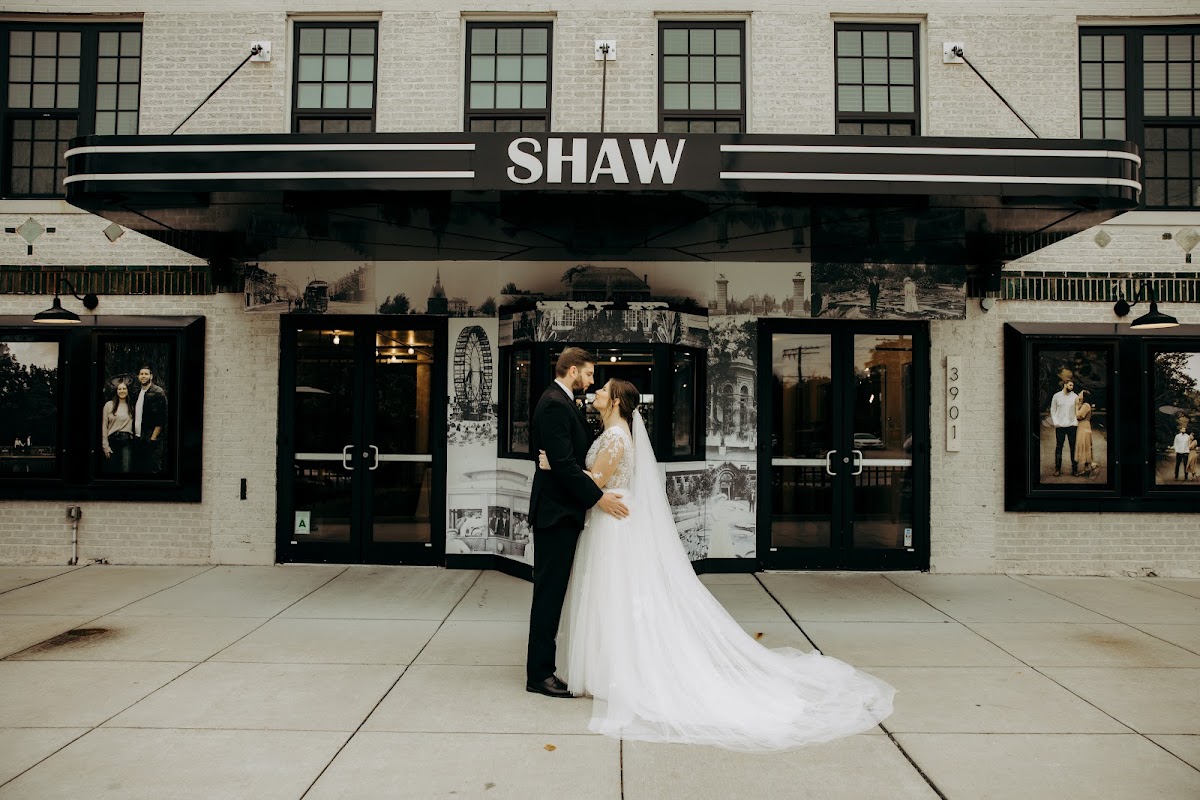
You approach on Shaw Boulevard through one of St. Louis’s most storied neighborhoods, past Tower Grove Park’s Victorian lamp posts and the Missouri Botanical Garden’s wrought iron gates, and then the marquee appears. Not a working marquee anymore — the Shaw Theatre went dark in the late 1960s — but the bones are still there, the reconstructed ticket booth standing sentinel beneath the historic canopy like a promise of something preserved. You walk through the front patio, past those old movie poster frames now filled with engagement photos instead of Bogart and Bacall, and push open the door. That’s when the full reveal happens. The shotgun-style space unfurls before you: 4,500 square feet of exposed brick, polished concrete, and those extraordinary barrel trusses arching overhead — massive curved beams salvaged from the theater’s original construction, now serving as both structural element and sculptural statement. Vintage furniture clusters dot the room in five distinct vignettes: Victorian settees here, Scandinavian minimalism there, mid-century credenzas against the far wall. And then you notice the garage door at the back, rolled open to reveal nearly 7,000 square feet of green space strung with lights, the urban garden that makes this venue something more than just another industrial loft conversion. This is a space that understands its own history — a 1920s movie palace reborn as a thoroughly modern celebration venue, theatrical in the best sense of the word. Poppy has designed Wild Carrot wedding flowers for one celebration here so far, with 35 leads in our pipeline, and every consultation begins with the same realization: this venue doesn’t need florals to compete for attention. It needs florals that understand the assignment is collaboration, not decoration.
About Wild Carrot
Wild Carrot inhabits the bones of the Shaw Theatre, a neighborhood movie house that first opened its doors in 1915 and entertained St. Louis audiences through the golden age of cinema until the late 1960s. The building sat dormant for years after that, the way old theaters do in evolving urban neighborhoods, until a restoration project brought it back to life as an event venue with deep respect for its theatrical DNA. The result is a space that manages to feel both utterly current and historically grounded — exposed brick walls show their age and their stories, the original barrel trusses create dramatic overhead architecture, and the polished concrete floors reflect light in ways that change throughout the day. This is not a fussy restoration. The brick is rough, the steel exposed, the paint accents delicate rather than perfect. It’s industrial in the sense that it doesn’t hide its construction, but elegant in how those raw materials have been curated into distinct design moments.
The main event space runs shotgun-style through the building’s footprint, an open 4,500-square-foot canvas divided only by the five curated furniture vignettes that create natural gathering zones. Victorian lounge pieces anchor one corner, Scandinavian clean lines another, mid-century modern credenzas and chairs a third. The eclecticism works because each vignette is internally coherent, and because the unifying architectural elements — those brick walls, those trusses, that concrete — hold the room together. Natural light floods in through high windows, and the mezzanine level adds vertical interest and another vantage point. A small wedding party suite sits within the main space for final preparations, and upstairs, the 3905 Getting Ready Suite provides 1,000 square feet of white-walled, naturally lit prep space with windows that overlook the main venue below, perfect for getting-ready photos and that moment when the bride sees the finished reception space for the first time from above.
But the real genius of Wild Carrot is what happens when you roll up that garage door. The urban garden courtyard sprawls behind the building, accessible directly from the main space through that dramatic opening — 7,000 square feet of green space strung with lights, ideal for outdoor ceremonies and cocktail hours that feel like a secret garden in the middle of the city. When the garage door is open, inside and outside become one continuous space, the industrial loft flowing into the garden without interruption. Close it, and the main space becomes a cozy, brick-wrapped cocoon. That flexibility is rare and valuable.
Location-wise, Wild Carrot sits in Shaw, one of St. Louis’s most charming and walkable historic neighborhoods, just minutes from Tower Grove Park and Forest Park, about 20-25 minutes from St. Louis Lambert International Airport. The area has a distinctly artsy, elevated vibe — this is not cookie-cutter suburbia but a neighborhood with Victorian architecture, independent restaurants, and the kind of tree-lined streets that photograph beautifully. For Poppy’s delivery logistics, parking is limited on-site (valet and shuttle services are often recommended for guests), but vendor load-in is straightforward with good access to the main space. Wild Carrot requires a day-of coordinator for all events and liability insurance for all vendors, though they welcome outside florists and maintain a preferred vendor list rather than enforcing exclusivity. The events team communicates well and understands how vendors need to work in the space. Beverage Director Luc curates an elevated cocktail program with bespoke drinks and scotch tastings, and catering comes from a preferred list or outside vendors — food trucks have been known to make an appearance.
Event Spaces & Floral Opportunities
Main Event Space
Capacity: 200 seated
Setting: The main event space is where Wild Carrot’s personality lives most vividly. Picture 4,500 square feet of exposed brick walls painted with delicate accents, polished concrete floors that catch and reflect candlelight, and those massive barrel trusses — relics of the old theater — arching overhead like the ribcage of some magnificent industrial beast. The space runs long and shotgun-style, with high ceilings that invite the eye upward and natural light pouring in through tall windows. Five distinct furniture vignettes punctuate the room: Victorian drama in one corner with tufted settees and carved wood, Scandinavian minimalism elsewhere with clean lines and neutral tones, mid-century modern credenzas and chairs creating lounge areas throughout. A mezzanine level adds vertical dimension, and a small wedding party suite sits tucked within the main space. At the far end, the garage door waits to roll open and reveal the garden beyond.
Floral approach: This room demands florals that work with, not against, its eclectic vibe. The multiple furniture styles mean you cannot choose one floral aesthetic and apply it uniformly — what works on the Victorian settee (lush, romantic, a bit wild) will look wrong on the Scandinavian sideboard (clean, architectural, restrained). We approach this space by creating floral moments that honor each vignette’s design language. For the Victorian lounge: overflowing arrangements in brass or mercury glass vessels, garden roses like Juliet and Patience, ranunculus in blush and peach, jasmine vine trailing down, scabiosa pods for texture. For the mid-century areas: low, horizontal arrangements in geometric ceramic containers, Quicksand roses, white lisianthus, succulents, perhaps a single statement orchid. For the Scandinavian pieces: bud vases with single stems, white anemones or tulips, minimal greenery, lots of negative space. The brick walls are your friend — their neutral rust-and-gray palette makes almost any color pop, and their texture complements organic, loosely structured arrangements. The barrel trusses overhead are begging for suspended installations: garlands of Italian ruscus and smilax running the length of the trusses with clusters of blooms every few feet, or floral chandeliers hung at varying heights to add drama without obstructing sightlines. For guest tables, consider varied heights and styles rather than uniform centerpieces — this space celebrates eclecticism, so embrace it. The polished concrete floor is perfect for large ground installations flanking the ceremony space or framing the garage door opening. If you’re setting up a ceremony in here before flipping to reception, the mezzanine can hold cocktail-hour florals that later become bar or escort card table arrangements. The key is intentionality: every floral choice should feel like it belongs to the specific design moment it’s enhancing, not like someone bought centerpieces in bulk and plunked them down uniformly.
Urban Garden / Outdoor Courtyard
Capacity: 200 seated
Setting: Step through that rolled-up garage door and you’re in a different world — 7,000 square feet of green space strung with lights, urban garden magic in the middle of Shaw. This courtyard sits directly behind the main venue, accessible through that dramatic garage opening, and the transition feels seamless when the door is up, like the brick loft simply extends itself into the outdoors. String lights crisscross overhead, creating a canopy of warm glow in the evening. The green space itself is open and adaptable, perfect for ceremony seating in rows or cocktail hour mingling with high-tops scattered throughout. The connection to the main space means guests can flow easily between indoors and out, and that garage door frame becomes an architectural focal point visible from both sides.
Floral approach: Outdoor ceremonies here benefit from a strong focal point that doesn’t try to compete with the string lights and greenery. A ceremony arch or chuppah should be substantial enough to anchor the space but organic enough to feel like it grew there — think a asymmetrical structure built from real branches (birch or curly willow work beautifully), densely covered on one side with climbing jasmine, Italian ruscus, and clusters of garden roses (Keira, Romantic Antike, Mayra’s Rose in soft peach and blush tones), café au lait dahlias, and trailing amaranthus. Position it so the garage door and main venue serve as the backdrop, creating a visual connection between ceremony and reception spaces. Aisle markers can be simple and impactful: tall glass cylinders filled with submerged greenery and floating candles, or low arrangements in aged terracotta pots filled with herbs (rosemary, lavender) and white blooms. For cocktail hour, the key is not to over-floralize — the string lights and greenery provide ambiance, so focus florals on the bar area (a lush garland running the length of the bar top with blooms tucked in, or elevated arrangements on brass stands at either end) and high-top accents (small bud vases or potted herbs guests can take home). If you’re doing a full outdoor reception, embrace the garden setting with centerpieces that feel slightly wild: loose, garden-gathered arrangements in mismatched vintage vessels, lots of texture from foliage, blooms that look like they could be growing nearby (foxglove, delphinium, stock, local wildflowers when available). The garage door frame itself can be outlined with garland on the courtyard side, creating a portal effect that makes the transition between spaces feel intentional and designed.
3905 Getting Ready Suite
Capacity: Prep space, not event space
Setting: Upstairs from the main venue, the 3905 Getting Ready Suite offers 1,000 square feet of calm, bright preparation space. White walls, natural light streaming in, modern furnishings that photograph beautifully, and — here’s the special part — windows that overlook the main event space below. This is where the bridal party gets dressed, where hair and makeup happen, where the bride can peek down and watch the final setup come together. It’s private but connected, a separate world with a view into the celebration to come.
Floral approach: This space requires a light touch. Getting-ready photos are about the people, not the florals, so arrangements here should enhance rather than dominate. We typically deliver the bridal bouquet to this suite early enough for it to appear in getting-ready shots — displayed on the modern furnishings or held by bridesmaids, it becomes a recurring visual element that ties the prep photos to the ceremony images. A single statement arrangement near the getting-ready station works well: something in a clean white or concrete vessel (to complement the white walls), with a soft romantic palette that flatters skin tones in photos — blush Quicksand roses, white ranunculus, touches of greenery, nothing too wild or colorful that could distract in images. The windows overlooking the main space are a photo opportunity: consider placing a small, delicate arrangement on the windowsill — perhaps a low bowl of floating flowers or a simple bud vase — that becomes a foreground element when photographers shoot the bride looking down at her finished reception space. Everything here should feel intentional but unfussy, elegant but not overdone. The 3905 is not where you make your big floral statement; it’s where you create a sense of calm, romantic anticipation through strategic, beautiful details.
Front Patio
Capacity: Pre-event gathering space
Setting: The front patio serves as Wild Carrot’s first impression, a 1,000-square-foot outdoor welcome area beneath the reconstructed historic Shaw Theatre canopy. The original ticket booth stands here, now repurposed for displaying engagement photos or welcome signage, and the concrete patio extends from the street to the venue entrance. Movie poster frames line the building’s facade, a nod to the theater’s past life, now filled with images of the couple rather than vintage film posters. This is where guests arrive, where they pause before stepping inside, where they get their first sense that this wedding is going to be something special.
Floral approach: The front patio is all about the welcome moment. This is not where you need elaborate installations, but you do want something that signals “you’re in the right place, and this is going to be beautiful.” A pair of large-scale arrangements flanking the entrance works perfectly — substantial urns or concrete vessels overflowing with seasonal blooms and greenery, sized to make an impact from the street. Think of these as the floral equivalent of a red carpet: they should feel generous and celebratory. The ticket booth offers another opportunity: display engagement photos here as planned, but add a small floral accent — a garland draped across the top of the booth, or a single arrangement in vintage style (to match the 1920s vibe) sitting beside the photos. The historic marquee and canopy provide great bones for minimal floral enhancement: a garland wrapped around the support posts, or a wreath hung on the venue’s front door. Because this space has such strong historical character already, florals here should feel like they honor that vintage theatrical aesthetic rather than trying to modernize it. Choose vessels and colors that could plausibly have appeared in a 1920s theater: brass, aged mercury glass, jewel tones in the blooms (burgundy dahlias, deep red roses, plum-colored carnations), greenery that has a slightly nostalgic feel (eucalyptus, olive branches). This is your chance to set the tone before guests even step inside, to hint at the transformation that’s occurred within these historic walls.
Mezzanine
Capacity: Not a standalone event space; adds dimension to main space
Setting: The mezzanine is an elevated level within the main venue, providing visual interest and an additional vantage point. It’s not a separate room but rather a lofted area that overlooks the main event space, adding architectural drama and vertical dimension. Guests can move up here during cocktail hour or reception for a different perspective on the celebration below, and it creates natural photo opportunities with the main space as backdrop.
Floral approach: The mezzanine’s primary floral function is to add vertical interest and create moments that are visible from the main floor. This is an ideal location for a statement piece that draws the eye upward: imagine a large arrangement on a pedestal at the mezzanine railing — something tall and dramatic that can be seen from below, perhaps featuring tall branches (curly willow or blooming cherry in spring), with blooms clustered at varying heights (Oriental lilies, gladiolus, hanging amaranthus). The elevated position means this arrangement can be taller and more vertical than what would work on the main floor without obstructing conversation or sightlines. If the mezzanine is being used during cocktail hour, consider placing several smaller arrangements along the railing that echo the main floor’s aesthetic — these become foreground elements in photos taken from the main space looking up, and they help visually connect the two levels. For ceremonies in the main space that flip to receptions, the mezzanine can temporarily hold larger pieces (ceremony arch florals, altar arrangements) during cocktail hour before they’re moved down for reception repurposing. The key is using this elevated space to add drama and dimension without making it feel separate from the celebration below — florals here should feel like they’re in conversation with the arrangements on the main level, echoing colors and textures while taking advantage of the height and perspective this unique architectural feature provides.
Wedding Flower Ideas for Wild Carrot
Theater District Romance
This concept leans fully into Wild Carrot’s theatrical heritage with a palette drawn from classic Hollywood glamour. Deep burgundy dahlias (Akita, Black Jack), crimson garden roses (Tess, Piano), and wine-colored ranunculus form the rich, romantic foundation, lightened by touches of blush (Quicksand and Keira roses in champagne-pink), ivory lisianthus, and cascading jasmine vine. The texture comes from burgundy-toned scabiosa pods, hanging amaranthus in deep mauve, and clusters of privet berries that read almost black. Vessels lean vintage and theatrical: aged brass urns, mercury glass compotes with patina, perhaps a few art deco-style geometric vases in brass or copper for the mid-century furniture vignettes. The overall effect is moody, dramatic, and unabashedly romantic — flowers that would feel at home in a 1940s film noir, but with enough texture and organic movement to avoid feeling stiff or dated. This palette absolutely sings against Wild Carrot’s exposed brick, and the deep colors photograph gorgeously under the string lights in the courtyard. Best deployed in the Victorian furniture vignettes, as lush centerpieces on guest tables, and in an abundant ceremony arch in the outdoor garden that uses those wine tones against the greenery backdrop.
Industrial Garden
Here we acknowledge both sides of Wild Carrot’s personality — the industrial bones and the garden heart. The palette is primarily green with strategic pops of white and barely-there blush: white anemones with their distinctive black centers, Playa Blanca roses, white ranunculus, and lots and lots of textured greenery. We’re talking Italian ruscus, emerald green hypericum berries, olive branches, jasmine vine, and trails of smilax creating organic, almost-wild shapes. Add in unusual foliage like sword fern, dusty miller for silver accents, and ornamental kale for unexpected texture. Vessels are deliberately industrial: galvanized metal buckets, concrete cylinders, matte black ceramic, perhaps some reclaimed wood boxes for the mid-century areas. Arrangements are built to feel garden-gathered and slightly untamed — very asymmetrical, plenty of movement, stems visible, that just-picked quality where you can imagine the blooms came from cutting gardens rather than a cooler. This concept works beautifully throughout Wild Carrot because it complements rather than competes: the industrial vessels echo the space’s raw materials, while the organic garden style softens them. Particularly stunning in the courtyard where the arrangements genuinely do feel like they grew there, and gorgeous suspended from the barrel trusses inside as lush green garlands with white blooms tucked in like surprise discoveries.
Mid-Century Modern Luxe
For couples who connect most with Wild Carrot’s curated furniture vignettes rather than its industrial architecture, this concept delivers clean-lined elegance with a distinctly mid-century aesthetic. The color palette is restrained: coral-peach as the primary color (Juliet and Romantic Antike garden roses, coral ranunculus, peach stock), accented with warm white (Patience roses, white lisianthus), and anchored by dusty green foliage (seeded eucalyptus, olive branches). Vessels are where this concept really commits to the mid-century vision: low horizontal arrangements in teak wood containers, blooms in minimalist white ceramic cylinders, perhaps a few brass and marble stands for elevated single-stem displays. The arrangements themselves are architectural — clean lines, visible structure, nothing overly wild or garden-gathered. Think: five stems arranged with intention rather than fifty stems arranged with abandon. Negative space matters here. Focal flowers are given room to breathe. This palette and style shine brightest in Wild Carrot’s Scandinavian and mid-century furniture vignettes where the aesthetic is already aligned, and as escort card table displays where the cleaner style allows signage and calligraphy to remain the star. For guest tables, consider groupings of three small arrangements in varied heights rather than one large centerpiece — more Don Draper dinner party, less English garden. The coral-peach tones are warm enough to feel romantic but modern enough to honor the mid-century vibe, and they photograph gorgeously against the brick and concrete.
Seasonal Considerations
St. Louis sits in USDA Zone 6b with humid continental climate, which means four distinct seasons with weather that can swing dramatically even within a single week. Understanding what’s locally available and how the Missouri climate affects both flowers and celebrations is essential for planning Wild Carrot wedding flowers.
Spring (March-May): Spring in St. Louis is glorious but unpredictable. March can still see frost, while May might hit 85 degrees and humid. Early spring (March-early April) brings locally available tulips, daffodils, and hyacinths if you want to source regionally, along with flowering branches (cherry, dogwood, redbud) that are spectacular in tall arrangements. By late April and May, peonies arrive — Sarah Bernhardt and Festiva Maxima are usually available from late April through May, and they’re worth planning around if you love them, though they’re temperature-sensitive (they don’t love hot setup conditions, so communicate with your florist about timing). Spring also brings unpredictable weather: outdoor ceremonies in the courtyard might need backup plans for rain, and temperature swings mean some blooms will hold up better than others. Stick with hardier spring flowers (tulips, ranunculus, anemones, stock) rather than delicate blooms that wilt in heat. The light in spring is beautiful and clear, perfect for photography in the courtyard, and the surrounding Shaw neighborhood comes alive with blooming trees and gardens. Best months for outdoor ceremonies: late April and May, when weather is most stable.
Summer (June-August): St. Louis summers are hot and humid — we’re talking 90+ degrees with high humidity, and that matters for flowers. Outdoor ceremonies in the courtyard should be timed for early evening when temperatures drop, and flower choices must account for heat. Heat-tolerant blooms are essential: zinnias, sunflowers, celosia, gladiolus, and tropical flowers like orchids and ginger all handle heat better than roses or peonies. If you love garden roses, communicate with your florist about setup timing and consider keeping delicate blooms indoors in the air-conditioned main space rather than outside in the courtyard. Hydration is critical — flowers will drink more water in heat, and foam-free designs (stems in water tubes or bottles) generally hold up better in summer than foam-based arrangements. The advantage of summer is abundance: locally grown flowers are at their peak, farmers’ market blooms are available if you want that farm-to-table aesthetic, and the lush greenery everywhere provides beautiful natural context for photography. The courtyard’s string lights shine brightest in summer when sunset comes late and the party can extend into the warm evening. Just be strategic: prioritize heat-hardy flowers, ensure your florist has a solid delivery and setup plan that minimizes blooms’ time in the heat, and consider keeping the most precious arrangements (your bouquet, head table) inside where temperature is controlled. Best months for lush greenery and garden vibes: June and early September, when heat is present but not oppressive.
Fall (September-November): Fall is Wild Carrot’s secret weapon season. September and early October deliver warm days and cool nights, ideal weather for both outdoor ceremonies and flower longevity. The Shaw neighborhood erupts in fall foliage — the drive to the venue becomes part of the experience, with tree-lined streets showing off autumn colors. This is prime season for dahlias (in every size and color imaginable), chrysanthemums (though choose carefully; some varieties read too “autumn festival,” while others like football mums are gorgeous and textural), marigolds for warm orange tones, and continued availability of roses and seasonal favorites. Fall also brings texture: ornamental grasses, seeded eucalyptus, berries (privet, hypericum), and branches with turning leaves. The cooler temperatures mean flowers hold beautifully both indoors and out, setup is comfortable for your florist team, and you can incorporate elements that would never survive summer heat (like chocolate cosmos or garden roses that prefer cooler temps). The light in fall is golden and warm, spectacular for photography in the late afternoon, and the courtyard takes on an almost magical quality when string lights come on over autumn evening air. Consider incorporating seasonal elements beyond flowers: small pumpkins or gourds as table accents, fall leaves and branches in arrangements, that warm burgundy-rust-orange palette that feels quintessentially autumn. Best months for perfect weather and flower variety: September and October, before hard frost arrives in November.
Winter (December-February): Winter weddings at Wild Carrot have a cozy, intimate quality — the main space with its brick and warm lighting becomes a refuge from cold outside, and the courtyard (while less likely to be used for ceremonies) can still function for photos or a brief champagne toast if properly heated. Winter flower availability shifts: no more locally grown blooms, but excellent availability of imported roses, carnations (which are vastly underrated and beautiful when used well), amaryllis, anemones, and evergreens. Greenery becomes crucial for winter weddings: pine, cedar, fir, eucalyptus, magnolia branches, and holly all bring that winter feel and photograph beautifully. Color palettes can go two directions: traditional winter whites, creams, and evergreens for a classic snow-inspired look, or deep jewel tones (burgundy, emerald, navy) for dramatic winter romance. The exposed brick and barrel trusses take on extra warmth in winter, and the space feels particularly theatrical with darker evenings and more dramatic lighting. Consider incorporating non-floral elements: candles (lots of them) for warmth and ambiance, hanging greenery garlands from the trusses, perhaps some seasonal elements like frosted branches or winter berries. Winter also offers budget advantages: roses and carnations are often more affordable than peak-season specialty blooms, and greenery goes a long way. The main concern is weather-related logistics: ensure your florist has a solid bad-weather plan for delivery, and if you’re using the courtyard at all, consider propane heaters for guest comfort. Best months for cozy indoor celebrations: January and February, when the industrial space feels most intimate and romantic.
Poppy’s Expert Take
Use the barrel trusses. Those massive overhead beams are Wild Carrot’s most dramatic architectural feature, and they’re structurally sound for hanging installations. We’ve successfully hung greenery garlands, floral chandeliers, and even suspended terrariums from the trusses. Work with your florist to create something that adds dimension without obstructing views — garlands that run the length of the trusses with blooms clustered every few feet work beautifully and create visual interest from every angle in the room.
Don’t fight the eclectic furniture. New clients sometimes worry that Wild Carrot’s mix of Victorian, Scandinavian, and mid-century furniture will make cohesive floral design impossible. Actually, the opposite is true: the eclecticism gives you permission to vary your floral styles rather than forcing everything into one aesthetic box. Use lush, romantic arrangements on the Victorian pieces, clean-lined minimal designs on the mid-century credenzas, and you’ll find the variations actually make the space feel more intentional, not less.
The garage door transition is your ceremony-to-reception secret weapon. If you’re doing an outdoor ceremony in the courtyard followed by an indoor reception, that garage door opening creates a natural reveal moment. We recommend keeping the door closed during ceremony setup so guests don’t see the reception space until cocktail hour when it’s rolled open and the full transformation is visible. The frame itself can be decorated with garland or floral installations that look beautiful from both sides, creating a portal effect between the two spaces.
Brick walls mean color pops harder than you expect. Wild Carrot’s exposed brick provides such a textured, neutral backdrop that flower colors appear more saturated and vibrant than they would against white walls. If you’re gravitating toward bold colors (coral, fuchsia, deep burgundy), know they’ll read even bolder here, which is either perfect or something to account for depending on your vision. When in doubt, bring a sample bloom to your venue tour and hold it against the brick to see how the color inter