
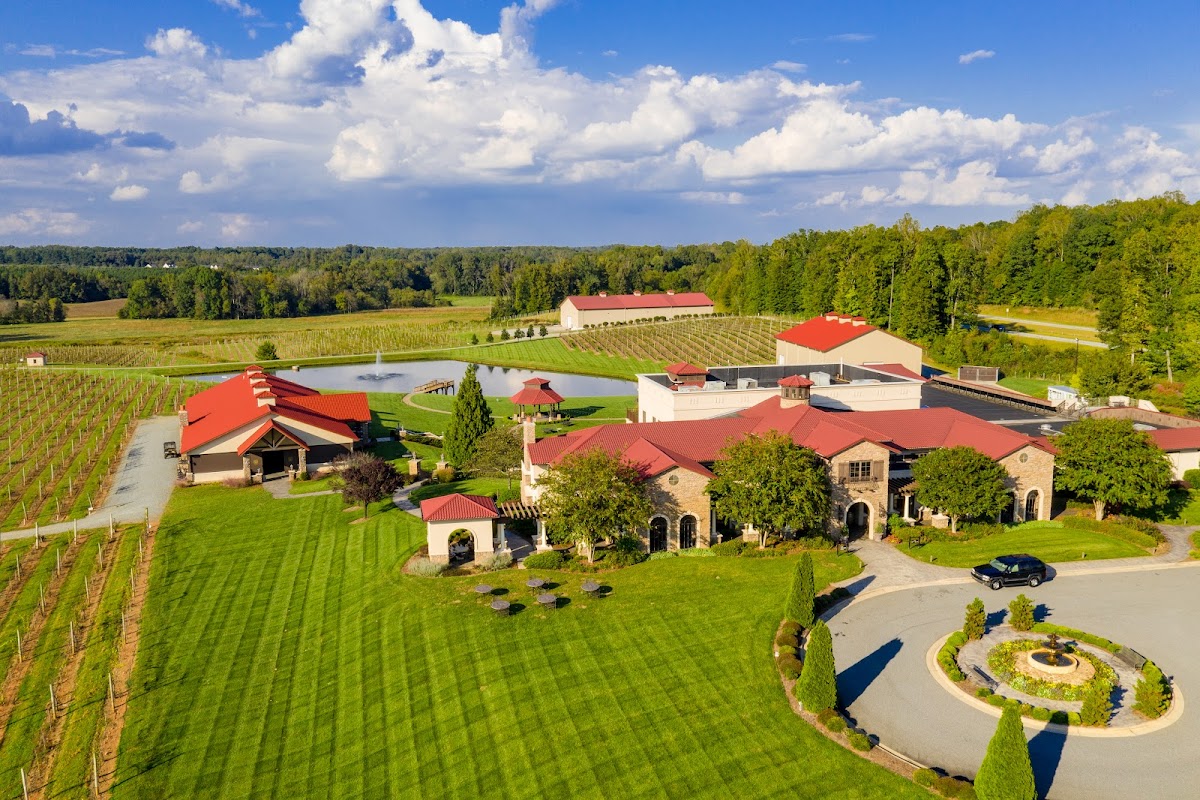
Designing at Childress Vineyards requires a sophisticated understanding of scale and stone. The venue’s Mediterranean-inspired architecture provides a heavy, permanent backdrop that demands floral designs with enough visual weight to hold their own against the masonry. Success here lies in lean, intentional choices that either mirror the organic lines of the vines or provide a lush contrast to the structured stone.
We know this venue well from our work here, and we approach the design through a lens of architectural enhancement. Whether you are leaning into the rustic warmth of the wine cellar or the airy grandeur of the Pavilion, the goal is to bridge the gap between the manicured outdoor landscapes and the textured indoor finishes.
The Spaces
Vineyard Rows
The primary outdoor ceremony site offers a dramatic, linear perspective. The vines themselves provide a repeating pattern that serves as a natural aisle. Because there is no overhead structure, the design must be entirely self-supporting.
- What works: Ground-level “nests” or semi-circular “growing” installations that appear to emerge from the grass. These frame the couple without obstructing the view of the rolling hills.
- Skip: Tall, spindly pedestals that look fragile against the vast horizon.
- Watch out: Wind. This is an open-exposure site. All installations must be weighted or built on heavy steel bases.
- Budget hero move: Use heavy, lush ground arrangements for the ceremony that can be repurposed to the front of the sweetheart table or the base of the band stage.
The Grand Pavilion
This is the venue’s architectural centerpiece for receptions. The dark wood beams and high ceilings offer a “blank canvas” of height that most North Carolina venues lack. It is a space that rewards vertical thinking.
- What works: Greenery smilax or Italian ruscus wrapped around the central beams. This softens the transition from the stone walls to the ceiling and makes the large room feel more intimate.
- Skip: Standard-height centerpieces that get lost in the vertical volume of the room.
- Watch out: The room has a lot of warm tones in the wood and stone. Ensure your floral palette includes enough “cool” or “bright” tones to create contrast.
- Budget hero move: Focus your budget on two or three beams rather than trying to lightly touch every single one. Concentrated impact always photographs better than a thin application.
The Wine Cellar
For rehearsals or intimate weddings, the cellar is a masterclass in mood. The low ceilings and stone alcoves create a subterranean, European feel that requires a completely different design logic than the Pavilion.
- What works: Long, low garlands for farm tables or clusters of varying heights in bud vases. Incorporate plenty of candlelight to catch the textures of the stone.
- Skip: Tall arrangements. They will feel claustrophobic and block sightlines in a space with this little vertical clearance.
- Watch out: Lighting is dim here. Deep purples or dark reds will disappear into the shadows; use mid-tones and whites to ensure the flowers are visible.
Stone Archways & Fountains
The transition spaces at Childress are often overlooked but offer the best photography opportunities. The stone archways and the fountain area provide a structured, “Old World” frame for portraits and cocktail hour.
- What works: Asymmetrical floral “crawls” on the stone archways. Using the architecture as a trellis makes the flowers look like an integrated part of the estate.
- Skip: Free-standing arrangements that don’t interact with the stone.
- Watch out: These are high-traffic areas. Ensure any floor-level designs leave ample room for guest movement.
What Works at Childress Vineyards
Saturated Palettes. The neutral tan and grey of the stone masonry can swallow pale, pastel-heavy designs. We recommend incorporating “bridge” colors—deeper tones like terracotta, burgundy, or even a vibrant peach—to ensure the arrangements pop against the architecture.
Organic Textures. To contrast the hard lines of the stone and the linear rows of the vineyard, use flowers with movement. Think ranunculus with curved stems, pieris japonica, or trailing jasmine vine. This softens the “estate” feel and makes it feel like a garden.
Structural Greenery. The Grand Pavilion is built for greenery. Smilax is the gold standard here because of its ability to climb beams and its longevity in a temperature-controlled indoor space. It provides the most “look” for the investment.
Clustered Bud Vases. On the cocktail tables and in the wine cellar, avoid single, lonely arrangements. Cluster three to five bud vases of varying heights. This mimics the abundance of a vineyard harvest and feels more intentional in the smaller spaces.
Ground-Anchored Ceremony. Instead of a traditional arch, which can feel “placed” on top of the landscape, we prefer ground-level floral crescents. This keeps the focus on the natural beauty of the Lexington countryside while still creating a clear altar space.
Budget Guide
| Tier | Investment | Floral Strategy |
|---|---|---|
| Essentials | $1,750 - $3,500 | Focus on personals and a high-impact ceremony ground installation that can be moved to the reception. Minimalist bud vases for tables. |
| Sweet Spot | $3,500 - $6,500 | Adds lush centerpieces for the Pavilion and a partial greenery wrap on one or two main ceiling beams. Enhanced stone archway decor. |
| Full Experience | $6,500 - $10,000 | Comprehensive beam wraps, elevated and low centerpiece mix, and full-scale floral “crawls” on the exterior stone features. |
| Statement | $10,000+ | Floor-to-ceiling floral installations, custom structures for the vineyard ceremony, and a fully transformed wine cellar with overhead floral clouds. |
Childress Vineyards is a venue that rewards those who lean into its European aesthetic; it is a place for “more is more” when it comes to texture, but “less is more” when it comes to competing with the view.
Tips
Plan for the gravel. The paths between the main building and the vineyard rows are gravel. This affects the stability of any rental items and requires your floral team to use carts with pneumatic tires.
Repurpose with intention. The walk from the vineyard ceremony to the Pavilion is a distance. Ensure your floral team has a clear plan for moving ground pieces quickly during the cocktail hour.
Embrace the seasons. The vineyard changes color dramatically. In late summer, the vines are lush and green; in autumn, they turn to gold and brown. Coordinate your ribbon and flower choices to complement the current state of the vines.
Weight your outdoor pieces. The wind coming off the hills can be deceptive. We do not recommend lightweight plastic urns or top-heavy pedestals for any outdoor installations at this venue.
Check the light. The ballroom has large windows that provide beautiful light in the afternoon, but once the sun sets, the stone walls can feel dark. Ensure your centerpieces have enough white or light-reflecting elements to stay bright under evening lighting.