
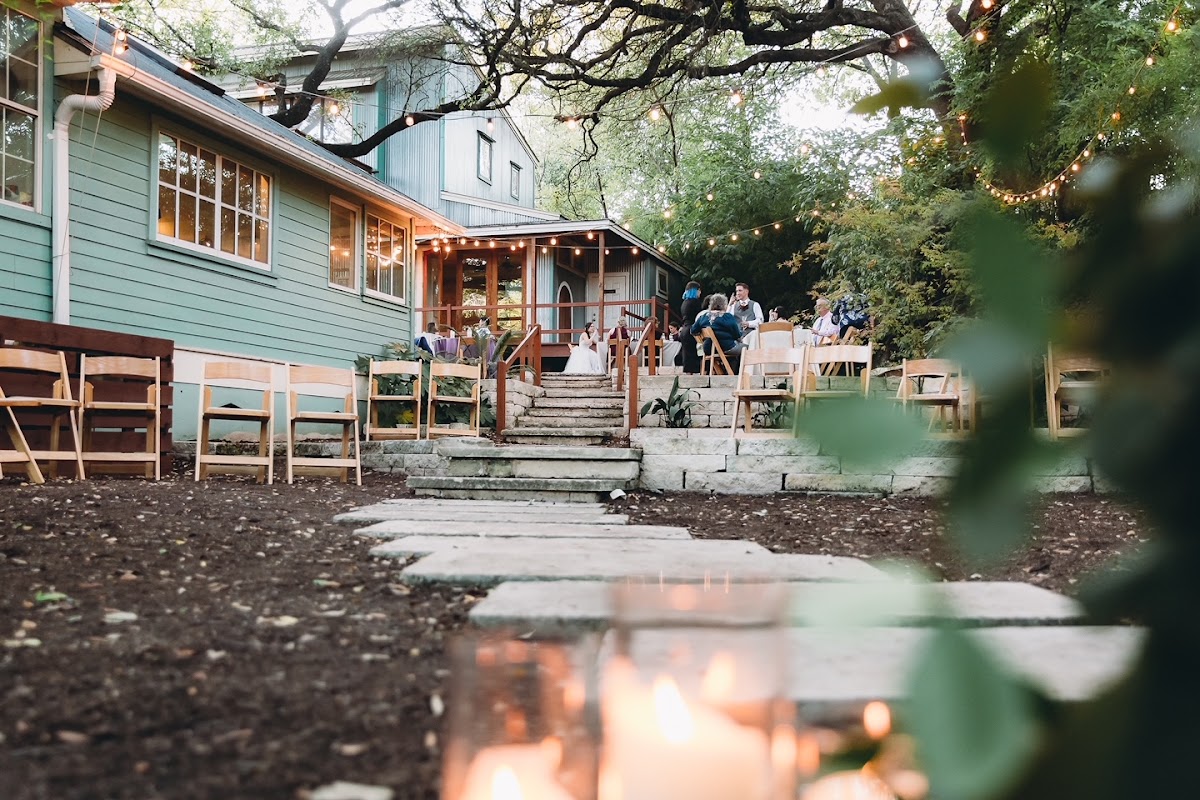
We know this venue well from our work here. Designing for The Sanctuary requires a deep respect for the existing canopy. This is not a blank-box venue; it is a living, breathing landscape where floral design should feel like an organic extension of the Bouldin Creek greenery rather than an interruption of it.
The primary design challenge—and opportunity—is the scale of the ancient oaks. Because the trees dominate the vertical space, ground-level floral installations must have enough visual weight to avoid getting lost. We focus on textural, garden-style arrangements that mirror the wilder edges of the property.
The Spaces
Grounds
The heart of the venue is the terraced outdoor area. Shaded by the oaks, this space functions as both the ceremony site and the reception grounds. The terraced seating accommodates 120 on the lower levels, creating a natural amphitheater effect that directs all eyes to the iron arbor.
- What works: Asymmetrical arbor installations that leave some of the ironwork exposed. Ground-level “meadows” that follow the curve of the stone terrace steps create a seamless transition from the aisle to the altar.
- Skip: Tall, narrow floral stands. The ground is uneven, and the visual competition with the tree trunks makes thin stands look spindly and out of place.
- Watch out: Wind and debris. Being under a heavy canopy means leaves and small twigs can drop into open-top arrangements.
- Budget hero move: Focus 70% of your floral budget on the arbor and the immediate ceremony foreground. Since guests stay in this general area for the reception, these pieces provide the highest ROI for photography.
Studio
This 622-square-foot indoor space is typically used for dancing or as a weather backup. When used for seated dinners, it caps at 65 guests, making it a very tight squeeze for large floral installations.
- What works: Bud vase clusters or low, lush compote arrangements. Because the space is climate-controlled, this is the best spot for more delicate blooms that might wilt in the Texas humidity.
- Skip: Elevated centerpieces. They will make the room feel smaller and obstruct sightlines in the compact footprint.
- Watch out: The “flip.” If this space is moving from a ceremony backup to a dance floor, ensure all floral pieces are easily movable by a single person.
Cottage & Balcony
The cottage serves as the getting-ready suite, but the tree-top balcony is the real architectural gem. It offers a unique perspective of the grounds and serves as a frequent backdrop for portraits.
- What works: A “growing” installation on the balcony railing using smilax or jasmine vine. It ties the structure into the surrounding oak branches.
- Skip: Large floor arrangements inside the cottage, as floor space is needed for hair and makeup kits.
What Works at Amala Foundation
Embrace the “Gathered” Aesthetic. This venue is the antithesis of a ballroom. Floral designs should feel effortless and slightly wild. Avoid overly manicured, tight spheres of roses; instead, opt for movement, varying heights, and plenty of local foliage.
The 91-inch Rule. The iron arbor is 91 inches tall. When designing for it, we recommend installations that focus on the top left or right corner and trail down. This creates a frame for the couple without overwhelming the narrow 58-inch width of the structure.
Textural Neutrals and Earth Tones. The venue is a sea of green and brown. To pop against this backdrop, use high-contrast whites and creams, or lean into the palette with ochre, terracotta, and deep burgundy. Avoid mid-tone greens that will simply disappear into the trees.
Repurpose with Intent. Because the grounds are interconnected, ceremony flowers can easily move to the reception. An arbor installation can be designed in pieces that later sit at the base of the sweetheart table or the front of the bar.
Lighting Integration. The Sanctuary has permanent string lights. Floral designs should account for these; avoid tall installations that might interfere with the light strands, and consider adding tea lights or lanterns to ground arrangements to maintain visibility after sunset.
Budget Guide
| Tier | Estimate | Description |
|---|---|---|
| Essentials | $1,750 - $2,500 | Personals (bouquets/boutonnieres) and a focused accent on the iron arbor. Ideal for intimate elopements. |
| Sweet Spot | $3,500 - $4,500 | Full arbor coverage, aisle markers that repurpose to the reception, and bud vases for farm tables. |
| Full Experience | $5,500 - $7,500 | Lush arbor, floor meadows for the terrace, statement bar piece, and full compote centerpieces. |
| Statement | $8,500+ | Tree-hanging installations, overhead greenery in the Studio, and high-density floral “walls” or paths. |
The Amala Foundation is a nonprofit venue, and the aesthetic is inherently soulful; your floral budget should prioritize quality of design over sheer volume to match this character.
Tips
Leveling is mandatory. The stone pathways and terraced dirt are rarely perfectly flat. All ground-level arrangements must be weighted and checked for stability to prevent tipping during the ceremony.
Tree-safe rigging only. If you plan to hang anything from the oaks, the venue requires non-invasive rigging. No nails or staples. We use heavy-duty fishing line or padded straps that won’t damage the bark.
Catering is DIY. Since the venue allows outside catering and has a limited kitchen, the floral load-in often competes with catering setup in tight corridors. We recommend a morning load-in before the food service teams arrive.
Candle safety. Candles are permitted but must be in glass chimneys or deep holders. Given the proximity to trees and the outdoor nature of the space, open flames are a significant fire risk and are generally discouraged by the venue.
Mind the driveway. Parking is extremely limited (2-3 spots). Florists should plan for a quick drop-off and off-site parking to avoid blocking vendor access for catering and rentals.